27.9.22

"Love Stories - Art, Passion and Tragedy"

Since the beginning of war in Ukraine, our local Hermitage in Amsterdam has had cut all the connections with the state of Russia, therefore  we also stopped with exhibitions with art from St. Petersburg. The building has two beautiful large wings and for a while it all seemed a bit underused - one wing had selected pieces from Amsterdam History Museum while the other would display one important painting and than milk it for all its worth, the rest of the rooms covered in a story about it - while I understand the principle behind cutting the ties with Russia, still it left the beautiful palatial building depressingly empty. And since Amsterdam History Museum is closed for renovation anyway, I complained why they just didn't move the whole darn thing here. 


Well, here comes a new exhibition called "Love Stories - Art, Passion and Tragedy" and would you know its actually genuinely best exhibition here since a long time - finally the large space actually makes sense and its perfectly used. The exhibition is about love between couples, but also love as inspiration for art and sometimes even between two artists. It follows love & desire from sixteenth century portraits to contemporary photography. It was great fun to recognise some of these portraits from London's National Portrait Gallery and I must say this was excellent - also very visited and crowded so it was good to see the museum finally enjoying the attention as it should have.


Amongst other things I was curious about part about the muses & inspiration: muses are inspiration but they are not necessary part of love couple, as in photographs by Welsh photographer Angus McBean who has taken some excellent pictures by black dancer Berto Pasuka. I was very much intrigued with pictures of both the dancer and the photographer, curiously they spoke to me and I very much loved their faces - I even went online to find more about the photographer who apparently was arrested for homosexuality and sentenced to four yours in prison (he served two). 


26.9.22

"Jaws" by Steven Spielberg (1975)

Another movie that I have just seen and enjoyed very much was the very first cinematic smash from a movie God Steven Spielberg - this is the movie that put him on a map and even though he has been directing before, starting from here his international career took off, followed by "Close Encounters of the Third Kind" and countless list of other successful movies. I know that in some circles he is the epitome of big budget Hollywood (and therefore, industry insider) but personally I make no excuses for the fact that his movies are great entertainment and escapism, therefore I no amount of nitpicking would ever make me forgetting my love for "E.T" or Indiana Jones or even his latest "West Side Story". 


I have no idea why I have never seen "Jaws" before - it could have been that the original screening happened while I was still too small and later it never came on TV. Subsequently, I have seen many Spielberg movies, in fact many of them fresh in the cinema (I still remember initial shock with "Jurassic Park") but this one was always at the back of my mind and finally this last weekend I decided to give it a go. It was excellent! In fact, much better than I expected from a 1970s movie - apparently the huge success of "Jaws" has changed the industry, starting from this point movies that were potential hits were released simultaneously nationwide and backed by huge advertising. Where previously the success of the movies depended on good reviews and summer was the low season for the cinema, "Jaws" has turned this all upside down and summer now became the best time for promoting blockbusters. Starting from here, new era arrives.


Movie itself is very interesting because between the lines the real monster is not shark itself but the local townspeople who refuse to close the beaches in the middle of the tourist season, fearing for their pockets and loss of profit if the visitors stay away. Death after death happens, it is very clear that there is a dangerous shark around the beaches and still they do everything to block efforts of sheriff (Roy Scheider) and a scientist (Richard Dreyfuss) who eventually prevail and team up with a hard-boiled local shark hunter (Robert Shaw). The movie is extremely watchable, despite its age and I enjoyed it immensely - except for Robert Shaw who, in my personal opinion was hamming it up too much and over-acting the role of the tough seaman - in comparison with the other two, he was just annoying, selfish and stubborn character. It was delight to see Richard Dreyfuss so young and fresh faced. 

"See How They Run" by Tom George (2022)

I have just pulled trough the monster flu that dragged on and on, leaving me completely exhausted to the point that I would just work and sleep. Apparently I was not the only one but that didn't help, it still alarmed me and I even took Covid test just to make sure its not something else - going to the cinema to see this, was the first sign that perhaps I am recovering, after all.

"See How They Run" was a delightful British comedy, kind if similar to "Knives out" (2019) so it is hommage to Agatha Christie type of mystery. Where latest Kenneth Branagh excursions in that same genre left me strangely detached and unimpressed (bombastic cinematography and big budget but no substance), these two were delight. I guess we could call them ensemble films because the most important thing about them is the teamwork, all star cast and their interaction. This latest one happens around celebrated Christie's theatre play "The Mousetrap" and the celebration of its 100th performance (I have checked, it has been 27 000 + so far) - naturally, the murder happens at the backstage of the theatre and there is perpetually hangover inspector (Sam Rockwell) and his hilarious, eager assistant (Saoirse Ronan) to solve the crime + the whole list of weird characters from the theatre world, including Agatha Christie herself (who gets to play with the poisons).


It was delightful! I was in the mood to see something entertaining and have always loved British cinema - half of witty quotes went above my head because I was too busy enjoying the madcap energy of the plot and excellent cast who has so obviously enjoyed themselves. True, it might confuse people who are not familiar with Christie or have never heard of The Mousetrap" but that is their problem and I see no reason why should the rest of us have to accommodate their ignorance (see occasional bad review). I was enjoying the movie so much that I didn't even mind a black actor playing Christie's archaeologist Max Mallowan - usually I find this type of politically correct casting just irritating but here the whole story was so zany that it made a perfect sense. In fact, I wouldn't mind if they create a sequel. 

3.9.22

Vacation and quality time

This year my birthday fell just around my vacation and as usual I had no intentions of travelling anywhere - I have travelled enough for one lifetime and have absolutely no intentions of spending time in a crowded airports, stations or anything that involves crowds. My perfect idea of vacation & rest is being off work but still here in the middle of busy city, with enough interesting things to do if I want to. 

One of the first places I visited was Museum Van Loon, a beautiful canal house that belongs to this family and open to the public - apparently it was some important family with properties in various places and they would spend a social season here, while living elsewhere. Its a very beautiful and quite glamorous building, but I wasn't interested in their wealth - what interested me the most was the living arrangements, how the servants had their space in the basement, etc. There is a quite spectacular garden and a coach house at the back, very quiet and serene place with atmosphere of a farm far away, completely silent and unlike being in centre of the city.


Another canal house was Willet-Holthuysen Museum situated at the end of Herengracht canal (and a walking distance from me) - I used to admire the garden and this was the first time ever to actually step inside. Completely different in personality, this one belonged to a couple where the bride Louisa Holthuysen was the one with the wealth and her husband Abraham Willet was a bohemian art collector. The couple was childless and left the property to the city, with request that museum bear both of their names. Unfortunately it seems that original furniture was sold out long ago by the early curators so what we see today is mainly reconstructed but the art and books collection is original. Again, there was a beautiful garden and a very touching collection of paintings of couple's pets. 


By far the most interesting visit was something I wanted to do for the longest time: again, the walking distance from me is a private collection called The Six Collection. This is a old and influential family that goes back for some 12 generations and mainly they are all called Six (with lots of sons called Jan Six) - originally from France, they moved to Amsterdam in 17th century and were always socialising with the most prominent citizens from the history. Trough marriages, family amassed a huge private art collection that is now on display but reservations must be made online - it was fairly easy and not complicated at all, the tour was conducted by a young student whom I left a nice tip - amongst other things on display, there were very interesting portraits of wealthy young brides wearing black dresses (black being expensive colour), ubiquitous portraits of dead children, a portrait that takes the whole wall of a room specially build to accommodate it and the best of all, a genuine Rembrandt portrait of one of the many men called Jan Six - this particular one was a mayor of Amsterdam and the painting was a gift from the artist, therefore his own vision and probably close to what he genuinely enjoyed (as opposite to ordered pieces). A famous painting "The Milkmaid" by Johannes Vermeer was also once here, but she was sold to Rijksmuseum and is now one of the most celebrated pieces there. 


I have also for the first time visited Artis Zoo that for the longest time I avoided, thinking that I probably won't enjoy seeing caged animals. Well, during one of my recent long walks I spotted a nice park across the canal and a giraffe in there - who was apparently perfectly fine in the open air - so I changed my mind and wanted to see it. It turned out a beautiful park with a lot of things to see, including insects, butterflies, lizards, lions, sea lions, elephants, giraffes, wolves, jaguar, zebra, monkeys, crocodiles, vultures, owls, etc. All the animals seem quite comfortable there and the space is relatively large, in fact the park is so big that afterwards I had to rest and take a nap - and still we have not seen absolutely everything. Seems like a place to visit several times to explore carefully all the details. 


Another landmark of the city is The Rembrandt House Museum that now I had visited for the very first time (it looks as this time I really took time to see all that I ignored previously). Contrary to what i expected, it was crowded but not too busy and the organisation was excellent - visitors were guided in direction that allowed them to explore perfectly reconstructed 17th century house. Bizarrely, we know into a smallest detail what was exactly in the house because all his properties were carefully listed and written down when Rembrandt became bankrupt and house was sold - thanks to these documents we are now able to completely reconstruct the interiors . It was very interesting, however, the thing that impressed me the most was a special kind of glass that allowed visitors to peek in the back side of the building but only on one side - if you look to the left (in private houses nearby) you can't see anything. So you can clearly see trough the window on the right, but the glass protects the view on the left. I have never seen such a thing and could not wrap my head around it. 


30.8.22

"Madres paralelas" by Pedro Almodóvar (2021)

I am so glad that yesterday I had pulled myself out of the funk (it was cloudy day with a strong air pressure) and willed myself into a walk to a local little art cinema Lab 111 - the place for a real film lovers - where they were screening latest Almodóvar. It was something I wanted to see for the longest time, but had to find out the place where they will use English subtitles + for some reason it did not appeal to any of my friends so I went to see it by myself. And loved every second of it.

"Madres paralelas" might be one of the best Almodóvar movies so far, but than he created so many that I would have to go back and re-watch the whole list in order to pick up the favourite. Trough the years I might have forgotten some, but I do truly remember "Women on the Verge of a Nervous Breakdown " and "Kika" as perfect examples of his particular genius - colourful, witty, madcap, feminist - and in fact I came in the cinema expecting another comedy, where this turned into very satisfactory drama. It reminded me a little bit of those old Hollywood women movies with usually strong actresses, where the story was focused on women's lives and men were kind of supporting parts. Here we have excellent Penélope Cruz and Milena Smit as two heavily pregnant mothers who bond while sharing same hospital room and later kept in touch, discovering that their lives intertwine in the most unexpected ways. This is Almodóvar movie so naturally he finds a spotlight for his favourite Rossy de Palma who plays a strong, independent and supportive best friend - actually most of the women here are strong and independent, as witnessed by Cruz when she decides to raise a child as a single mother and says that every woman in her family was a single mother. There are some very interesting meditations on motherhood and connection with children - not only the two main characters are single mothers, but there is also excellent Aitana Sánchez-Gijón as example of different type of mother, the one who does not sacrifice her whole life for a baby (in her case, she actually puts herself in the first place) - since we are conditioned to expect mothers must be self-sacrificial, it comes as a surprise that we actually understand her. Israel Elejalde is forensic archaeologist who must be here, because he is somebody who makes Penelope's baby but otherwise he is mostly out of picture - almost like a mirror image of those old movies where pretty women were mostly decorations while men did the real job. I cannot elaborate anything more about the story because its important that viewer experiences it himself but I must say it was one of the best movies I have seen recently. It made me realise how little I know about recent European cinema - all these actors are celebrated in their homeland and I had no clue about their work. Just like with the music, there is a huge world outside of English language market. Funny how I never paid much attention to Penélope Cruz and she was excellent here, in fact everybody - to a statist - was. 


26.8.22

"The Sandman" television series (2022)


Just like with everything else, I am slowly accepting that its not possible to read all the books, hear all the music and watch all the interesting programs in the world. Yes, it fuels my imagination but there are some human limits after all - mostly my own attention span - so basically the next best thing is to organise my little piles of things to read, music to hear, movies to watch eventually. I am on a vacation now and my main motto is not to oppress myself with any plan or programme, there is absolutely nothing that I must do (except when bladder calls for alarm) so I am pleasantly relaxing, doing absolutely nothing and keeping one eye on potential TV shows.


Out of curiosity I have checked out long awaited and much hyped "House of the Dragon" but I'm afraid its impossible to experience the same thrill as with original "Game of Thrones" - its like expecting to fall in love for the first time again - we have invested eight seasons (and years) in the first one and its not realistic to be swept away again. To be honest, creators of this new show had ungrateful task of creating something that must be faithful to the original but still fresh and new. In other words, to me it felt very much as déjà vu - dragons, long haired men, backstabbing court intrigues and slices of nudity/blood/gory. I even left it for another day and watched the ending later. Right now I don't have sufficient interest to continue watching it, no matter what the rest of the planet might say or do. 


On the other hand, I am really thrilled with "The Sandman" - for the same reasons I disliked rehashed "House of the Dragon" - this is something completely new, fresh and as yet undiscovered. I am aware that series is based on a famous comic book written by Neil Gaiman but I have never read them (however, I am familiar with Gaiman and some of his work, namely "The Ocean at the End of the Lane" (twice!), "Good Omens" and "American Gods")  so this is all completely new to me and I even resisted my curiosity and have not read anything online about the plot: good decision, because TV series turned out very exciting, kind of dark Harry Potter fantasy with its own rules and myths. I could definitely tell this was based on comic book because it has a comic book feel to it, there are many interesting characters and in fact, where it took me two days to finish one episode of "House of the Dragon", I swallowed 5 episodes of "The Sandman" at once. Tonight I will watch the last two episodes and I genuinely love this. 

23.8.22

Alphonse Mucha in The Hague


Vacation time and the very first thing I wanted to do was to visit exhibition in The Hague about Czech maestro Alphonse Mucha and his celebrated Art Deco work - even though the man himself was reserved about belonging to any group or clan, but we lump him together with Art Deco for the sake of chronology. I have loved and admired Mucha's work for the longest time but probably saw his work for the first time in real life last year in The Allard Pierson Museum on “Goddesses of Art Nouveau“ exhibition, that made a point of explaining how the artists of the time successfully adapted to new commercial trends, namely advertisements and posters for various products. 


This is in fact how Mucha became famous, since as a painter he was starving artist who depended on goodwill of local financier (Count Belasi) and a struck of good luck around New Year 1894. when he got commission for creating theatrical poster for latest Sarah Bernhardt play. I was always fascinated with stories how people actually become famous and in this case it was a lucky break - nobody else was available during Christmas holidays, Bernhardt insisted poster must be ready by 1. January and Mucha was available. The highly stylized poster was something completely new for Parisians who were so impressed that many posters were in fact stolen from the walls - Bernhardt herself was pleased with the reaction and gave Mucha a six year contract. 


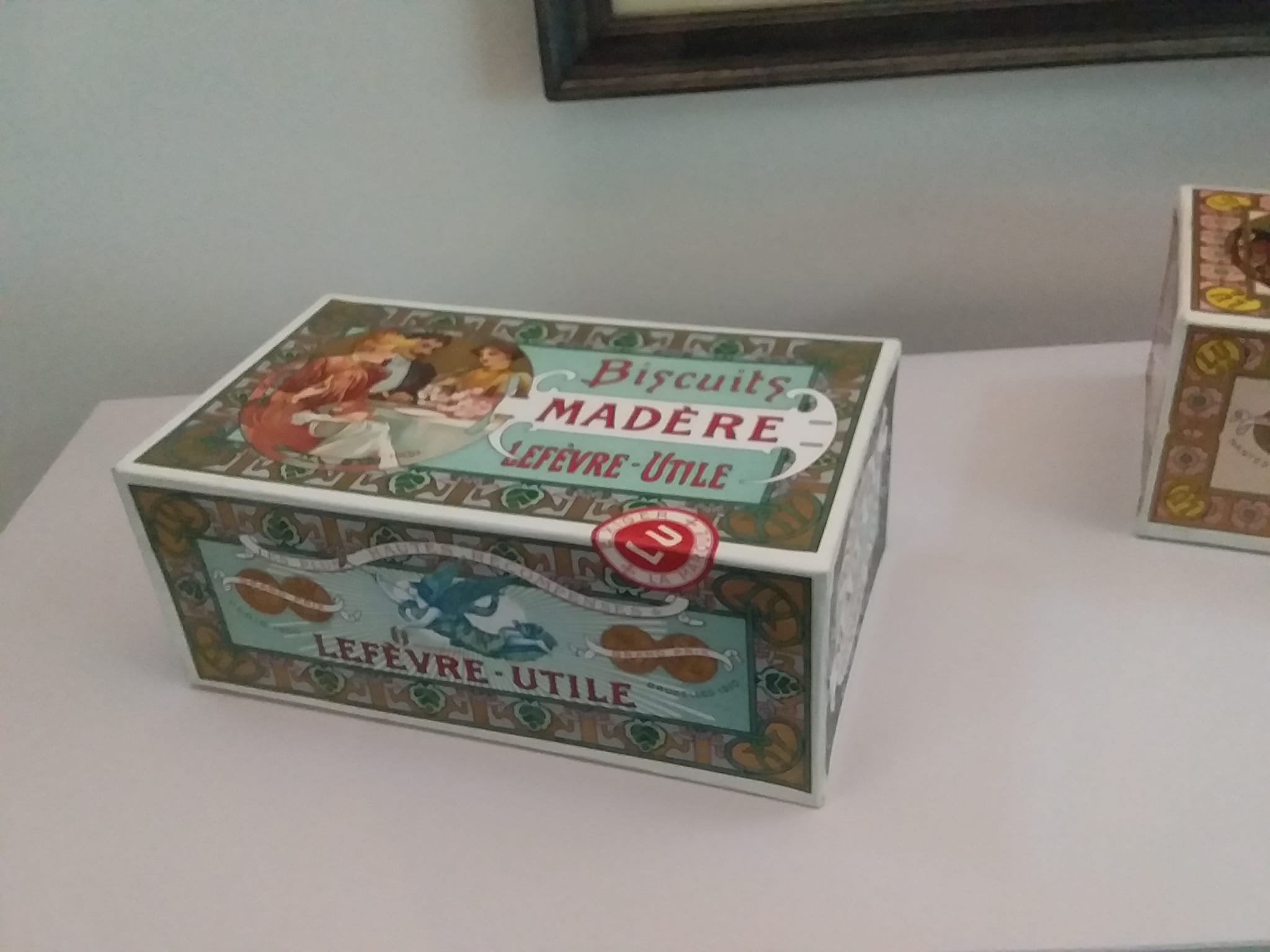
The exhibition in Hague's Kunstmuseum was very beautiful and various aspects of Mucha's creative work were all nicely covered - there was a very good introduction to his beginning, breakthrough with Bernhardt and all sorts of work later, including posters for bicycles, boxes for cookies, etc. To my biggest surprise the place was actually genuinely crowded, even though this was almost the end of exhibition and the public interest was still great. There was a lot of effort made to illustrate the times when Mucha worked, particularly his time in late 19th  century Paris. It was joy to see his famous work so well represented and displayed handsomely in a beautiful building - I have even seen his famous "Four seasons"  and many others. The rest of the building was nowhere near as interesting, since lot of space was unfortunately given to modern art that was in a sharp contrast with Mucha, to me it mainly appeared annoying. Somehow it just made it even more clear how much are we removed from somebody of his stature. 


6.8.22

"The Possessions of Doctor Forrest" by Richard T. Kelly (2011)


It was long since I have read a book with actual genuine pleasure. It seems that Internet has affected out attention span and for a while I do reading more like a task, trying to get in touch with my old self but its more or less always conscious decision "I must go back to reading like before" and not real satisfaction. And voilà, it did happen completely unexpectedly - not by any of the books I have bought, not from my overcrowded e-library (that looks impressive but its just too loaded) but one of those random books that I collect from free giveaway public libraries that people here so nicely put on display in cabinets so you can just take them for free. It was such a joy to dive into this book that I decided right now that I will only follow my impulse and go for random books I find like this, because somehow I have a feeling books find me and not the other way around. 


Also, it was the circumstances: I have spent the weekend in the nature, completely offline, enjoying the solitude and quiet of a little weekend cottage escape. hidden in the greenery, surrounded with quiet buzz of bees and chirping of the birds, somehow I relaxed enough to actually enjoy the book and get really into it, without glancing online all the time. 


"The Possessions of Doctor Forrest" is a modern day gothic novel, kind of combination of several famous literary predecessors like "Dr. Jekyll and Mr. Hyde" and what impressed me most was the writing style which was luminous. In fact, I am not sure was I enjoying more the story or simply the style - every now and than, the author would come up with some really beautiful turn of the phrase and I loved it so much that I returned to the pages again and again. Apparently its not very successful nor big hit and that is fine by me, I gulped it in two days with greatest pleasure and felt thrilled about my newest discovery. Loved it, loved it, loved it! 

5.7.22

"Crawford: The last years : an intimate memoir" by Carl Johnes (1979)


Of all the Classic Hollywood stars, nobody suffered such complete and utter posthumous humiliation like Joan Crawford. Surely, she was not the only person whose image and screen persona were artificially designed by Metro-Goldwyn-Mayer - it could be said that this was a very standard procedure back in the day - but all her lifelong efforts to present herself as a elegant, classy lady were irreparably damaged in 1978. (just one year after her death) when notoriously, her adopted daughter Christina Crawford exposed her as a manic, abusive personality who mentally and physically tortured her children when outside of media attention. That in all of this, Christina herself appeared selfish and opportunistic, almost didn't matter - audience lapped up the autobiography "Mommie Dearest" (later made into a famous movie) and ever since, whatever Crawford did during her lifetime, her 50+ years in cinema, is eclipsed by the trashy tell-all book by spiteful, disinherited daughter.


Because she was a huge star in her time, there are many books written about Crawford - from the top of my head I recall excellent "The Divine Feud" by Shaun Considine (based on lifelong rivalry of Crawford and Bette Davis) and "Possessed : the life of Joan Crawford" by Donald Spoto - outside of posthumous scandal, Crawford is known for amazing longevity in a famously fickle and unpredictable industry, where she somehow managed to grown and mature from 1920s Flapper girl into high fashion beauty and later, elderly but still magnetic lady. I do need to focus more on her filmography, because for some reason I remember only "What Ever Happened to Baby Jane?" and there were tons of excellent (?) movies before that, I think I vaguely remember delightful 1930s "The Women" and 1950s "Autumn Leaves" - even without knowing anything about her, one is intrigued with total artificiality of her screen personae, where contrary to Bette Davis (who was always totally immersed in her acting), Crawford appears so knowingly self-aware of every moment, her over-the-top demeanour inviting all kind of conclusions and interpretations. There was a curious moment when director Robert Aldrich decided to break her classy lady routine and gave her a spiteful dialogue to scream in "Autumn Leaves", almost as he instinctively knew what lies under the surface: ""Where's your decency? In what garbage dump, Mr. Hanson? And where's yours, you tramp?...You, his loving, doting, fraud of a father. And you, you SLUT! You're both so consumed with evil! So rotten! Your filthy souls are too evil for hell itself!"  


"Crawford: The last years" is a lovingly written, affectionate memoir written by Columbia Pictures editor Carl Johnes as a reaction to malicious "Mommie Dearest" (published a year earlier) in attempt to show a different side of Crawford that he himself witnessed trough the years of their personal friendship.These were Crawford's autumn years where she slowly but surely disappeared from public life and only occasionally invited guests in her apartment for the rounds of backgammon - for whatever reason, Crawford took a shine to young Johnes and enjoyed his attention, inviting him over and over again until they bonded in mutual affection. Sure, the point could be made that Crawford presented herself as she always wanted - immaculately poised, generous and stylish, not the face that her step children saw - and Johnes is well aware that she always took great efforts to play the star for him. Still, its refreshing to read something positive about Crawford, after all the public humiliation and somewhere between the lines there is a portrait of lonely and elderly beauty still craving affection and attention. 


1.7.22

The Birth house of Jacob Olie


He is now the institution of Amsterdam and probably the most famous early photographer of the city, but in his time Jacob Olie was actually a carpenter and photography (than a completely new, still relatively rough novelty) was his hobby.Which means he toyed with it passionately trough his whole life, experimented with various techniques and this was who he really was - a photographer of Amsterdam, the way it was during his lifetime. Obviously he recognised that the city is rapidly changing right before his eyes and he wanted to preserve some of the images for the posterity - nowhere in a million years he could have guessed that long after his death, he will be celebrated for this hobby and that there will grow a whole industry of books, posters, postcards and memorabilia based on his photographs. 


I was mesmerised with his photographs from the very first moment - for me they were a personification of time travel - and even had a beautiful poster from some exhibition, made from his enlarged photograph. The Amsterdam City Archives owns approximately 5,000 photographs that he originally made on glass plates. I think its just amazing that we have his beautiful work saved and on top of it that in his lifetime photography was not even so well known yet - he will become celebrated posthumously. 


I have stumbled completely accidentally on the fact that his birth house still exist and made a point of taking a walk there. It is a very interesting area called The Western Islands (De Westelijke Eilanden) which apparently used to be warehouses and shipyards close to the busy port, only recently re-constructed into a very chic residential areas. It looks absolutely lovely and it feels as the time had completely stopped there - walking there in silence, one hears only birds chirping and its a soothing pleasure to take a walk trough small streets and countless bridges, far away from the city bustle and the noise. And here I found the house where Jacob Olie was born and lived - lovely little street with ancient houses overlooking the harbour. 


Interesting link with Jacob Olie photographs here