6.5.21

"Nomadland" by Chloé Zhao (2020)

I am so glad to start the month of May with something genuinely great, it is the latest "Oscar" winning movie with a big fuss made about being the first award given to Asian female director - but honestly, I was really enjoying the movie for its story, depth, insight and the thoughtfulness - while the questions of director's gender and race might be interesting to some, it is the movie itself that moved me and got my attention, this whole media attention kind of misses the point if this is all they will talk about. 

The story follows middle aged Fern (excellent Frances McDormand) who struggles to survive as a nomadic temporary worker here and there, while living in her van. Along the way she meets others who are (for various reasons) in the same situation and who help her with practical advices about this nomadic lifestyle and how to move South when the weather turns cold. It is quite grim, stark contrast from the idealistic picture of America that we got used to - this America is not a promised land but a bare, unfriendly and cold wasteland where elderly, lonely and forgotten people bond over the bonfire in a desert, singing together, talking, laughing and sharing their grief. Without going too much into detail, I can say that Fern is sort of Odyssey looking for her home - trough the movie we discover more about her background, but its all done very cleverly in layers that slowly peel one by one - finally its not even about one particular thing but as her sister (Melissa Smith) says, she was always a brave outsider yearning to be elsewhere. 


The movie is incredibly slow-burning beauty and it demands your whole attention - no big car crashes or explosions here, this is all about understanding how heroically and stoically Fern copes with everything that life throws at her. When warned that she can't park on this particular spot overnight, she simply goes away. When her prized ceramic plates crash, she glues them. No matter what kind of job is available, she will do it. Sometimes its numbing (like in Amazon packing plant), sometimes pleasant (in a sunny car camp). And just like mythical Odyssey, she meets all sorts of people - who are thankfully, mostly friendly and lost just as she is - there is even a young man into whom she bumps accidentally twice and recites him some Shakespeare - it is heartbreaking to understand that she is stronger of the two and he might be on the downslope. 


I thought it was brilliant - very interesting, thought-provoking, makes you think not about movie itself but about bigger picture, like life, our place in it, the people that we meet, the bonds we made, what is really important, our connection to material possessions, etc. A friend was commenting how much we are attached to our material possessions and right in the middle of the movie we had to stop and discuss this, because I disagreed - Fern is a perfect example - there is absolutely nothing that I could not live without - all my material possessions are just that, material things and they can all disappear in an earthquake or whatever - what matters is what I keep in my heart and my mind (and even that is not guaranteed to stay intact), really we are like a leaf in the wind and all that matters is how we touched people along the way and did we help somebody. Every single person in this movie carries his or hers own cross, what they do is help each other to ease it just a little bit. 

25.4.21

Addio, Milva

Sad news - Italian singer Milva have died this weekend and with her gone, this is now a twilight of the Gods. Some time ago I wrote about her being - along with Mina and Ornella Vanoni - one of the three main female cornerstones of Italian pop music. All three completely different, respectful to each other and incredibly successful in their own right. Inevitably, listener is moved to compare them but they are genuinely excellent artists worth listening and had carved their own signature.

All three had to go trough typical Italian showbiz route - big festivals, San Remo, TV entertainment shows - before they established themselves and became brands. If Ornella was a tender crooner and Mina a weary, sophisticated lady, Milva was a theatrical red haired volcano, gifted with a spectacularly resonant voice - judged by the merit of the voice only, she might technically be the best singer of all three. Hers was a voice that happens once in a century, a deep contralto that has nothing to do with American rock music and everything with old Bel Canto school of singing (I am sure she must have been trained as a singer) and this might be one the reasons why at certain point in 1970s she became restless and started exploring other music directions - theatre, Bertold Brecht, Tango, Ennio Morricone, etc - before moving on to German and French market. Eventually, Germany, France and Italy all honoured her with national awards - I am talking about knighthoods and Order of Merit. 


Hers is a delightfully eclectic discography that goes all over the map - as expected, 1960s were all about big, Italian ballads and bombastic San Remo numbers but later she gets really interesting and there is a certain willingness to experiment and artistic curiosity that is almost unique amongst big stars who tend to set in their own ways. The sheer amount of the records means that I am always stuck somewhere in the 1960s but actually the older she got, her repertoire got better and more varied. Although she stayed a big concert attraction for the long time, it seems that recording-wise she fell out of fashion at certain point (the destiny of many music veterans) and I remember that browsing trough Italian music shops, I could hardly find her albums - which is strange, considering how big and important she once was. Right now Italian media is praising her to the skies but I feel its a bit too late, she was fairly forgotten in the recent years. Curiously, one of the last pictures published on her Facebook page was the one where lady gets her vaccine, with a message "I get vaccinated because I care about my life and other people's lives. Do it too. We need to get back to life before, and hug our loved ones. Together we can all manage to defeat this virus."  Sadly, she passed soon afterwards but left a beautiful afterglow behind her. I will always love her. 


21.4.21

"The Haunting of Alma Fielding" by Kate Summerscale (2020)


I complained about Kate Summerscale's previous book ("The Suspicions of Mr. Whicher") but at the end read it twice and even bought one copy as a gift. She has a meandering way with storytelling but her subjects are fascinating so I will continue to go on with her work, even though sometimes I wish she go on with the story instead of trying to explain the social contest and background of each character mentioned along the way.


"The Haunting of Alma Fielding" is another true-life story that happened in the twilight of 1930s, just as WW2 was becoming a serious threat. Some kind of panic and fear is already in the air, no wonder that so many people were intrigued with spiritualism, seances and ghosts. It might as well be reaction on uneasiness and atmosphere filled with danger. Hungarian emigrant Nandor Fodor works at the International Institute for Psychical Research but so far he had not find any genuine medium - he was successful at unmasking the fraudsters but he came to the point where his job is at the risk and needs to find a proper person, someone who is truly a miracle worker.


And voilà - here comes suburban housewife Alma Fielding, around whom furniture moves by itself, dishes crash all over the place and even radio smashes on the floor by itself. Even more bizarre, Fielding produces various objects from her sleeves, like jewellery, gloves, etc. And she claims to have no idea how did they get there. Fodor is excited but naturally cautious so when he invites her over to Research center (where she is paid for each visit), he has the whole army of witnesses and helpers who can testify that Fielding is real deal. In the separate toom, Fielding is strip-searched and checked before she falls into trance and speaks possessed by a ghost named Bremba. Other people in the group started smelling unpleasant odours during seances and they generally felt alarmed and uneasy in her presence. As the experiments progressed, Fodor notices that Fielding often seems strangely detached from herself during seances, almost like she is not present and he started to wonder is this perhaps not about a ghost but about mental disturbance.


This is where experiments get more brutal - the more Fodor is suspicious, the more it gets obvious that Fielding does everything to continue being the centre of attention, including perhaps cheating (there are strong hints that she was fraudster) but we can still not explain weird phenomena around her. Just when Fodor started to suspect this is all a reflection of her suppressed memory and she might have created Poltergeist out of long-buried traumas, the colleagues in the Institute demand closure of the experiment - they don't like the direction this research is taking and its all abruptly stopped and swept under the rug. Later we find out that no other but Dr. Freud approved of Fodor's experiments and found the theory completely reasonable and possible.  

4.4.21

"The city on strike" documentary (2021)

 Last night I did something for the very first time - I actually sat in a front of a Dutch documentary screened on a local TV and decided to give it a go with help of Dutch subtitles (I would have probably cheated but English was not available). The movie was titled "De stakende stad" ("The city on strike") and was actually premiered at the end of February, when there is annually a memorial day in remembrance of  famous 1941. February Strike. I had already walked around old Jewish neighbourhood and saw people placing flowers on a particular spot but never knew a real background behind it so this just came as a perfect introduction to a dark chapter in Amsterdam's history.

What happened is that as Germans entered The Netherlands, they immediately started with intimidation of large Jewish population - for centuries Jews were always arriving here and specifically Amsterdam was known as a safe place, where all over Europe there were fires, persecutions and pogroms. Like elsewhere, there were always locals willing to join the invaders, in this case they were known as NSB (The National Socialist Movement in the Netherlands) and they basically persecuted people much more than Germans, because they were extremely focused on showing their zealotry. They would intimidate and beat up Jewish citizens, scare the bar owners from serving Jewish customers, etc. At the very start of 1941. they marched to Waterlooplein (same place where today is a flea market and most of the tourists have no idea what happened here) to beat up Jewish people there - Jews were not waiting helplessly but were armed and helped by communists so there was a huge street fight that left Nazi collaborator Hendrik Koot dead on the ground. He was found holding a rubber hose with iron in his hand so he was obviously caught intent on beating up people but the media described him as "brutally murdered by cowardly terrorist Jews" and made it sound as he had multiple wounds. This was the main reason for two major raids in February 1941. when 427 random Jewish men of age 25-30 were arrested and brought to Jonas Daniël Meijerplein and from there deported to concentration camp. Only two of them survived the war.

It happened on a Sunday morning so lots of citizens of Amsterdam who were on the markets, saw what happened and the news quickly spread around the town. The Communist party quickly organised a full-blown protest against the treatment of their fellow Jewish friends and colleagues - on 25. February all the trams stopped and majority of companies were on strike. Even the ferries bringing workers to their works were on strike. To my knowledge it was the only full blown, open protest of citizens in the whole Europe against the treatment of Jews. The general strike in fact spread to other cities as well - Zaandam, Haarlem, Hilversum, Muiden and Utrecht - The Germans responded to this strike with brutality, arrests and even executions (9 people were killed), the city of Amsterdam was fined with 15 million guilders. 

The documentary deals with not just a strike but also a destiny of some of the men arrested and found on the photos taken by Germans on that morning. Since the men were arrested randomly, they all came from houses nearby and it was a task of the curator Wally de Lang to unearth the identity of the people who were simply taken away and gassed later as a revenge for death of Koot. There are several interviews with elderly men who were there at the time but none of them could really recognise any faces from the photographs. All the men on the photographs were looking away but there is one haunting face looking directly at the camera and all these years nobody knew his identity - in the documentary we see archivists and historians interviewing everybody but nobody knew who he was. Perhaps the hunger, stress and terror changed his face beyond the recognition or maybe he perished together with the rest of his family so nobody remembered them anymore. It was truly tragic and we were following with great interest as curators and historians searched ancient photo archive of all people who lived in Amsterdam at that time (they have tons of pictures taken for the passports and various documents) - they really looked on face upon face until finally they found him and matched the gaunt, despaired face with the handsome photo from a passport. He was leather worker Izak Lemberger who was only 19 and therefore probably the youngest person arrested in that raid - when his family arrived from Krakow, he was only 5 and he lived in a nearby Nieuwe Amstelstraat so this is how the raid worked, they basically arrested everyone in the neighbourhood, house by house. None of Izak's family survived the war. It is just heartbreaking to find the real identity of that unlucky young man who was just starting his life and to compare these two pictures. I can never walk by that square without thinking what happened here. 


1.4.21

"Tina" documentary by Dan Lindsay and T. J. Martin (2021)


Well, I'll be damned (to paraphrase Joan Baez) if that story is not just growing bigger and bigger like some diamond that gets different colours every time we look at it from various angles. And honestly, you would be forgiven if you think that you know everything already: after all, there has been a 1986. autobiography written with Rolling Stone journalist Kurt Loder, 1993. movie with Angela Bassett and Laurence Fishburne, not one but two musicals about her life (2012."Soul Sister" and much better known 2018. "Tina: The Tina Turner Musical"), the second part of autobiography titled "My Love Story" and number of unauthorised paperback biographies that basically repeated themselves. And its not even the first documentary about her: youtube has excellent 1992. "The Girl from Nutbush" and there are several VH1 "Behind the music" variations. But it takes a Oscar awarded team to re-tell the story again, look at it from different angle and actually make it more exciting than ever before. I am seriously bowled over how Lindsay and Martin took a well-known story and somehow managed to give it a new life. This is some serious craftsmanship here. 


Like millions around the world, I have "discovered" Turner in 1984. when she exploded with "What's love got to do with it". To this day I remember where I was and who was with me as we watched than immensely popular MTV and our reaction to the video clip. And how our teenage heads exploded as someone so confident and strong sashayed on the TV screen. She was older, bolder and sexier than anyone we knew. And in a way, looking back I can say it was quite a sensational to see an older woman re-entering pop music arena and wiping out the floor with all those other kids. Pop music than (even more now) was always more about new fresh faces - the veterans had their place but we actually never heard of someone who was 45 and at the top of the charts - it was unheard of than and frankly it would be today. 


As Turner grew bigger and bigger, it was joy to witness her enormous success as a solo artist all over the world and it seems she really accumulated a lot of good will amongst everybody, people were genuinely excited and happy for her. Naturally I soaked in all the discography, all the books, video clips, concert recordings and interviews. Along the way I have also discovered a whole cornucopia of interesting knowledge about much older, R&B scene in 1960s where she was standing next to giants like James Brown or Wilson Pickett. It was a world she left behind but for a skinny-ass white boy like me, this was super exciting. I mean, this was not some manufactured starlet, this was someone who survived "chitlin circuit"  and is now selling out football stadiums. Unbelievable. 


"Tina" is collage of several different interviews recorded during various decades: you might call it her different incarnations. Today's Tina is a mellow, little lady sitting in her elegant home on the lake in Switzerland, than there is a younger Tina recorded as talking to Kurt Loder who was preparing the book and than there are 1981. audio tape from the very first interview where she explains why she left her ex husband and her voice is still raw with pain and emotions, the wounds were still too close. On top of this, you get a smorgasbord of well documented photos and sensational live performances recorded exactly at the time when the story is happening - this might be the very first time we see a documentary celebrating her as an artist and not talking about her legs or sex appeal.


Than there is a story - its fascinating to see how media became obsessed with it and always came back to it, no matter how big or successful Tina became. The ubiquitous questions and glee about confronting her with them time and time again, makes for uneasy watching - perhaps she was naive in expecting that autobiography would explain her reasons and now it actually backfired at her. Its apparent that Oprah just won't let it go and just loves to bring it up again and again, to the point that we see Tina's obvious discomfort and distaste. Perhaps this is the best thing about documentary - to face the audience with their own glee in all of this, so they might actually understand what it does to her and how she deserves to be spared from opening old wounds. We love to think about her as powerful and strong, but they actually bring her nightmares. Her husband Erwin Bach compares it to post-traumatic stress disorder that soldiers feel years after they have returned from a war. And honestly people, her solo success by far overshadows and eclipses anything that came before. 


Eventually the documentary goes into story with much more understanding and detail than Hollywood movie (I am actually surprised how many people claim they know everything because they have seen the movie) - when Tina earlier claimed "I would have liked the movie to be closer to the truth" many just assumed she meant that it was exaggerated, where actually movie was softened and condensed - what you see here, well documented with photos, interviews and witnesses is heartbreaking and intense, raw, brutal story not just about domestic abuse but what preceded it (both of her parents left her to grandparents and just disappeared), the treatment of women in 1960s music industry, her uphill struggle to gain a footing in business that has already written her off as too old and too black, even the way she works in a music studio where a completely silly pop fluff (already recorded by Eurovision winners Bucks Fizz) is turned into a worldwide smash hit. In fact, there is so much material that you wish this could be TV series, because there is just not enough space for everything - wisely, the directors trimmed the story to its main minimum, otherwise we could have two hours just of people celebrating her. The documentary eventually finishes as celebration of Turner and her well deserved status, we even see her enjoying life in Switzerland and between the lines there is a feeling of her wanting to be left in peace now.  It was heartbreaking, it was cathartic, a genuine emotional rollercoaster and I have cried my eyes out. Will watch it again. 


p.s.

I managed to write the whole essay and not mention his name even once. Good, she deserves to be praised and celebrated for herself. 

26.3.21

"Late Spring" by Yasujirō Ozu (1949)

A little background: I really disliked celebrated Korean 2019 movie "Parasite" to such degree that I even asked myself am I stranger to Asian cinema. After all, besides Akira Kurosawa I don't really know much about Far East cinematography and if pressed, could probably just name a few titles or actors but nothing more. Director Yasujirō Ozu apparently comes from the same generation like Kurosawa and is highly regarded but unknown to me - until I was obliged to watch this movie, my very first introduction to his oeuvre. It took me a few attempts, because nowadays I suffer from short attention span and can hardly watch a movie in one setting (forget about reading books) but finally I did finished, with some serious rewinding and re-visiting earlier scenes. 

First of all, there is a superb, clean version available on youtube and the movie is glorious in a sharp black & white technique. It really looks stunning and this might be the only movie that I have ever seen where every single scene makes a sense and I would not take anything away from it. The story itself is interspersed with glimpses of the nature that serves almost like a Greek choir commenting on the happenings. It is very simple story - so much that it took me some time to accept it because it felt so mundane, Ozu just loves to linger on things that have no genuine importance except creating the atmosphere. It is about the elderly widower Chishū Ryū (I feel strange describing him as elderly since he is actually close to my age) who lives quietly and contentedly with his grown up daughter Noriko (Setsuko Hara) until the whole family started pressuring her into marriage - the reason being that at 27 she is already dangerously close to status of old maid and if her father died, what would happen to her. 


The rest of the movie feels like a big drama happening under the calm surface of the lake. Everybody is super polite and bowing, smiling and exchanging pleasantries while leading Noriko to a pre-arranged marriage that feels like a slaughter. Neither she or her father are truly happy with what is going on but the social pressure is too strong. There is a meddling aunt who is really pushing this subject, although to be honest she feels genuinely happy once the arrangements are being made. Noriko herself is all polite smiles and giggles but my impression is that her character and feelings are completely hidden behind this mask - the mask drops only when she finds out that her father plans to re-marry and basically replace her with someone else who will mend his socks and pour his tea. 


It is difficult to understand what exactly this movie meant to contemporary audiences because we are so far removed from 1949 that to us this is all very alien. From the very first scene (where Japanese ladies enjoy a tea ceremony that looks extremely formal and stiff) everything is this movie seems very old-fashioned and lovely but stylised - all the characters here are politely nodding and bowing to each other, all the women are subservient and here only to please men of the house. Even the lovely Noriko who definitely has her own mind is basically shoehorned into a marriage with someone she met only once and although its perfectly clear that she would rather stay with her father, she must play her role and go away, because this is expected from her. (There is a very, very Freudian thing about this father and daughter harmonious life together, in one unforgettable scene we witness that they even sleep next to each other so its basically a marriage in all but consummation) At the end they both make sacrifices believing its for each other, but ultimately it feels a bit pointless as neither father or daughter will be truly happy. Not sure did this occur to Ozu but the story does feel a bit incestuous between the lines or its just me watching it from a different perspective. It is a very, very slow burning movie with a lot of big emotions rolling somewhere deep under the surfaces and quite impossible to compare to anything else I have seen. 

23.3.21

Long walks and discoveries: Old Jewish neighbourhood (continued)

I enjoyed writing my previous post so here are some more pictures of the Jewish quarter than and now. What is very interesting is that when all these re-buildings happened (mostly after WW2) there was not much concern about historical value of the old buildings - which were, mainly, badly neglected but not without a chance to save and perhaps reconstruct - so for various reasons, the whole streets were erased right in the centre of town and it took few decades before someone finally said "Stop, we must keep and protect our historical buildings" - I think the turnaround started in 1970s but unfortunately before that a lot of beautiful old houses were destroyed.  


What you see on these pictures don't exist anymore. Right in the heart of the centre, near famous Nieuwmarkt, the whole street Keizersstraat has been demolished in order to make space for new buildings - I am not 100% sure but these beautiful old houses might be victims of the new underground line that was eventually done nearby. Apparently the locals were not amused and there were huge riots with police involved. I have no idea who came up with these horrible designs and who assumed that these new buildings will be better than what was previously here. It is such ugly and intimidating sight right in the middle of otherwise charming and historical area, that I avoid even walking there. 


Not far from this monstrosity is a famous Flea market - as I have mentioned previously, this whole area was once a crowded Jewish quarter and after WW2 everything was erased and swept under the rug, except Rembrandtshuis which stood here since centuries ago and thankfully everybody understood its historical value. Right at the corner there used to be something else entirely and nowadays there is a strange construction that might be fine elsewhere but have absolutely nothing to do with old historical centre and the cute churchyard behind it. It pains me to walk here. 


I do understand that after WW2 city officials wanted to re-build the old, neglected neighbourhoods and make space for new apartments, offices and different kinds of buildings, however when compared before and after, I can't help but to feel alarmed with such cold-heartedness - the whole areas were erased, removed and rebuilt in such a decidedly unsentimental manner that it often seems almost like sadistic disregard for the city. This is Valkenburgerstraat. 


Nearby used to be Markenplein that was basically completely erased - this was also a heart of Jewish district and was brimming with old, historical houses - however because its such good location, city officials decided they need roads and tunnels and whatnot to go exactly here on this spot so never mind the old buildings, everything must go and it was eliminated. What you see nowadays gives absolutely no glimpse into what used to be a busy neighbourhood.


On the pictures above is Rapenburgerstraat, another victim of re-building. Since this was deep in the heart of Jewish quartier, most of its citizens were arrested and deported during WW2. Imagine the whole street packed away in concentration camps, horrible. If you walk here nowadays, you would probably never guess this used to be a completely different neighbourhood. Apartment buildings and its all very quiet but I dislike such disregard for history.


In the middle of all this, there is a tiny house with a old, historical entrance - I was immediately smitten and intrigued to find out what is this. It turned out that it used to be a corridor into a extremely poor courtyard and the whole area was actually a slum - long ago there used to be a gunpowder factory here. The house was called Bussenschuthofje (Bus shelter) but the meaning of this name was lost long time ago. Several families used to live in a courtyard houses and the old photos show very desolate and depressing backside of this entrance. It looks as property was changing hands very often and somehow, miraculously this entrance was saved, protected and kept all this time. If you walk today trough what is basically a completely new street, its the most charming little mystery. I absolutely love it.


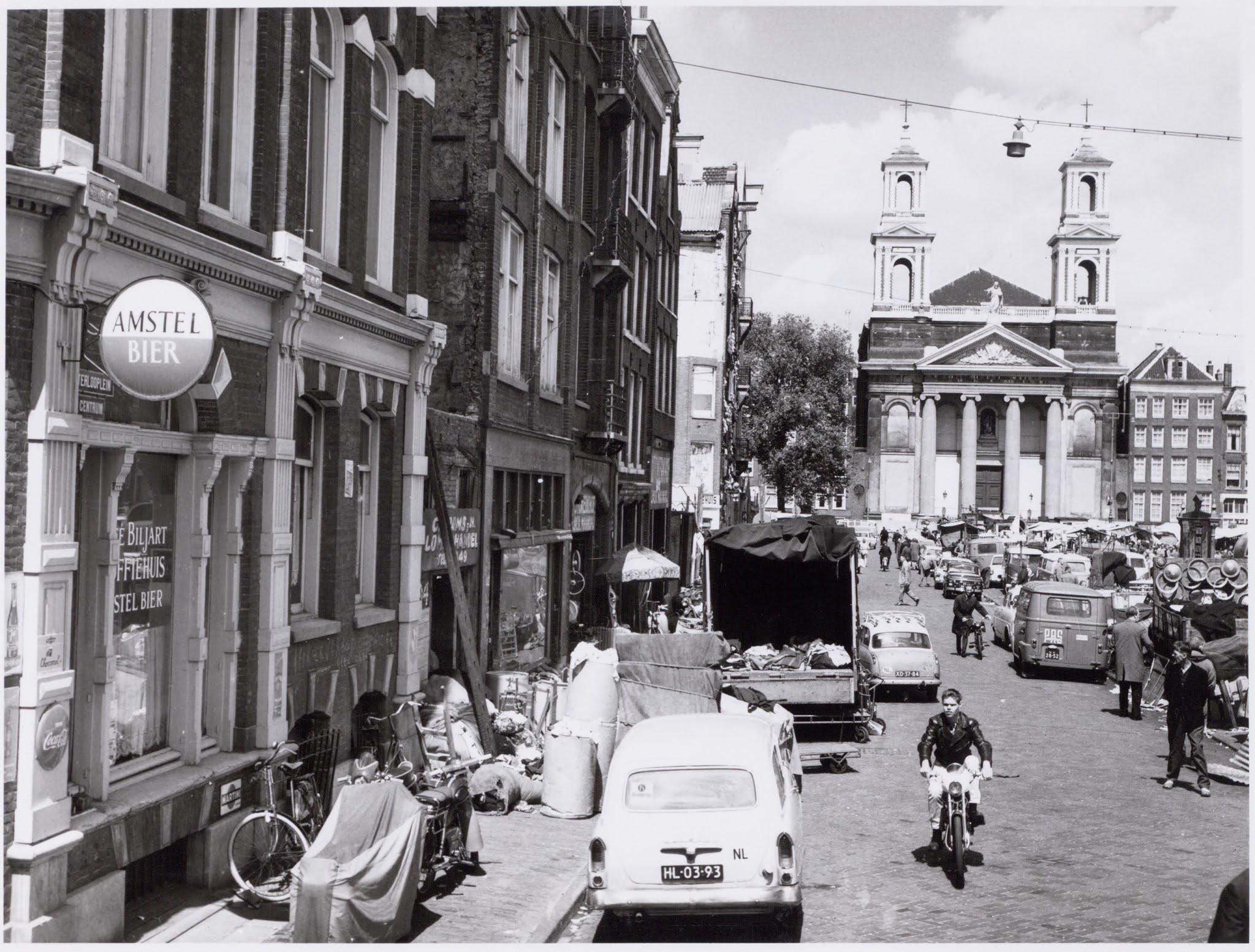
The square Waterlooplein actually deserves its own chapter and essay because this used to be a heart of the Jewish quarter and for centuries served as a marketplace for Jewish street traders. Dominated by The Mozes en Aäronkerk (which thanks God, still stands here) the square was always a crowded street market and trough decades was one of the most popular spots in the city. During WW2 it became gathering place for raids, than houses around it became empty and deserted (as the people got arrested and deported), locals helped themselves with wood for fire during the war and eventually it became a ugly reminder of all the atrocities made here trough the war. Instead of finding some decent way to remember hundreds of people who used to live here, the city officials decided the best thing to do would be to erase everything and build apartment buildings, a new city hall and Opera house here. To me it feels and looks as the heart of city was forcefully pulled away and replaced with some plastic Lego pieces. Everything except Church is now completely new and it looks nothing like what it used to be.


23.2.21

Long walks and discoveries: Old Jewish neighbourhood

Last time I wrote about Kattenburg and how the whole neighbourhood was erased to make space for the new apartment buildings. Still, Kattenburg was not so central as the Old Jewish neighbourhood which was actually right in centre of the city and was eventually almost completely obliterated, for various reasons. Not only that the area was poor, neglected and overcrowded but during the WW2 the majority of Jews living here were arrested and sent to concentration camps, while the houses fell in disrepair (in other words, their nice neighbours stole everything from these houses and later used whatever they could as a firewood). After WW2 the decision was made not to rebuilt these houses but to erase everything and create the new neighbourhood instead. So it came to be that famous, vibrant Jodenbreestraat was completely destroyed, re-designed and widened. Judging by the old photographs, it was a very important street full of people and it was a heart of Jewish quarter - Rembrandt used to live here, in a house initially owned by art dealer Hendrick Uylenburgh. I walk here almost daily and its just amazing how completely everything from the past was erased, with utter indifference what it meant for the heart of the city. Rembrandt's house had to be preserved but almost everything else was forever gone and rebuilt to give space for the new apartment buildings. 


The perfect example how utterly destroyed this neighbourhood became was situation around beautiful historical building knowns as Huis De Pinto - built in 1605, this was a house of wealthy Portuguese Jewish family and for centuries was right in the heart of the Jewish district but after WW2 the whole area was completely devastated and destroyed - mind you, not by the bombings or the war but by the Amsterdammers themselves who abused and stole everything they could from the empty old houses whose owners were arrested and deported. At certain point this beautiful old house was literary the only house still standing - the municipality had other plans (to destroy it and to built a motorway here) but the demonstrations and riots prevented this. Everything else is new but Huis De Pinto still stands on its original place.


Right across the street from Rembrandt's house is a funny little crooked house, now serving as a restaurant - The Gosler House is literary the only thing still standing from the whole area and its fascinating to see the city archive collection, where it shows that this little house (owned by Abraham Gosler who was killed in Auschwitz) was once on the corner of the neighbourhood known as Joden Houttuinen - this whole area was demolished and on its place now stands a very modern school of arts. The old photographs are brilliant and they show countless little houses and a very crowded neighbourhood that once stood here. Apparently it was the slum where only the poorest lived. 


Uilenburg is the old Jewish quarter right opposite of Rembrandt's house. Originally the place for the warehouses, it became Jewish area around 17th century and was known as the poorest part of town, overcrowded and  dilapidated, even before WW2. In fact, the municipality tried to re-design and re-construct the whole area since beginning of 1900s - nowadays there is only one wide street (Nieuwe Uilenburgerstraat) where two narrow streets used to be. During WW2 almost everybody who used to live here was killed in concentration camps. If you walk here today, it looks like a perfectly serene and quiet neighbourhood but in fact it has a long past and it was one of the busiest areas of town. 


For example, what you see today as a concert venue, was originally built at the beginning of 1900s as a public bathhouse for all the people in the neighbourhood who had no baths in their homes (Amsterdam had several of these). It looks perfectly fine now, but before 1900 there were two streets on this spot and if you check the old photographs, its mind boggling how much the city has changed in the meantime. 


The complete elimination of old historical areas right in the centre of city was not over - the municipality had also set their minds on erasing the old market squares around Marken and Waterlooplein. When the plans came to destroy the old historical quarter around Nieuwmarkt (to make space for the new Metro line) this was the last straw - the citizens passionately fought to keep the old houses and there were genuine riots, fights with police and resistance from residents. This constant demolition had to be stopped. Once you find about this, it makes you wonder how anything was saved at all.