7.11.17

"A Very Fine Love" by Dusty Springfield (1995)


Going back where it all started - after all, she had her real breakthrough as a member of The Springfields right here in Nashville, back in 1962. - newly rediscovered Britain's pop icon enjoys the belated renaissance and media attention, but where collaboration with Pet Shop Boys placed her among than cutting edge chart toppers, on her own Dusty Springfield shows surprisingly careful (dare I say, middle-aged?) approach and unfortunately results are very generic and bland.

Its easy to be blinded by Springfield's reputation and subsequent health issues - apparently at this point she was already very ill and recording was difficult - but for all her alleged perfectionism and fastidiousness in the studio, the selected material is surprisingly unadventurous. Where once, long time ago, she broke the ice with her covers of Motown and was willing to take risks recording with mighty Jerry Wexler now elderly veteran settles for fairly mainstream collection that has Nashville more as suggestion than the fact - there is occasional guitar twang or two, but otherwise this is not a country recording. There is a duet with Daryl Hall and a few ill-chosen uptempo ditties that distantly evoke 1960s but by far the best are ballads and some are scorching indeed - "I Can't Help The Way I Don't Feel" is beautiful and the final song "Where Is A Woman To Go" ranks amongst the best things she ever did in the studio. Still, two songs can't really save the whole album and one wishes that Springfield dared to push the envelope just a bit more, since her recent chart success suggested she could easily stand tall again amongst the relevant artists. Old recordings are deservedly classics but this one kind of slips under the radar unless you are fan touched by poignancy of what became her farewell. "Go Easy On Me" might surprisingly move listener familiar with circumstances in recording studio. 

"Dragonwyck" by Joseph L. Mankiewicz (1946)


Obvious attempt to follow the very successful footsteps of 1940."Rebecca" and 1943."Jane Eyre" this Twentieth Century-Fox costume extravaganza is another costume drama that throws naive young governess into cobwebs of a impressive manor where she is welcomed by candle waving housekeeper and intimidating landlord. Based on novel by than very popular Anya Seton, it has very small variations on theme (story is set in United States, the girl is not a governess but a "companion" to some spooky child, etc) but by now we more or less know what to expect and even though the script brims with potentially effective sidelines, these were never really explored because focus is on pretty heroine who is mostly twirling around and exclaiming "Golly Moses".


Gene Tierney of course, was one of the Hollywood's most celebrated screen beauties and she was very pretty to look at indeed, but this role didn't exactly give her much else to do besides being gullible country girl who dreams of escaping her parent's Connecticut farm because she "wants to see the world". Once she sees the world, it all comes down to wearing pretty dresses and giving orders to servants, basically she is still locked up inside of the house except that now this is life of luxury so its OK. Her stern parents (excellent Walter Huston and Anne Revere) are far more interesting characters but they are quickly removed from the scene, because they represent everything Tierney wants to run away from, after all they read family Bible, never dance waltzes and cook their meals on a simple open fire, which can't compare with porcelain dinner table in Dragonwyck Manor. Housekeeper is creepy, the wife (Vivienne Osborne) high strung and the child sleepwalks but Tierney can't care less because now she can run up and down the stairs in a new dresses - that snobbish society don't exactly welcome her is just a slight annoyance, she is like some distant relative of Crystal from "Dynasty", kind of out of her depth here in all this wealth but sure she could get used to it and learn which forks to use. 


Even with this beautiful woman constantly parading her frocks and locks, our attention inevitably wanders off towards the charismatic owner of Dragonwyck who is no else but very young and surprisingly suave Vincent Price. He is captured here at the very interesting crossroads in his career as from here he could easily go into direction of becoming next matinée idol but there was some darkness suggesting other possibilities and sure, next thing you know, he became horror icon. Once Tierney arrives in Dragonwyck, the script follows predictable routes and we can more or less guess each next step, so there are no big surprises here. Its all done with a obviously huge budget and wrapped in a grand cellophane, but lacks the spark and originality of its predecessors. Besides Price, the main attraction is lovely Jessica Tandy (a lifetime before "Titanic") as Irish servant girl with a heart of gold. 

6.11.17

"The Boys from Brazil" by Franklin J. Schaffner (1978)


Utterly strange and compulsively watchable despite obviously dated 1970s cinematography, the main asset of "The Boys from Brazil" is story based on the novel by Ira Levin, the guy behind "Rosemary's baby" and "Stepford Wives" - if it all appears far-fetched and borderline fantastic, well this is what made Levin worldwide famous, he successfully explored the possibility of monsters amongst us, evil hidden beyond ordinary, everyday faces.


Still big names at the time, although rusty around the edges, elderly Gregory Peck is matched against no other than theatre legend Laurence Olivier - it must have looked good at the posters and it was definitely a crowd pleaser but I genuinely wished that producers used some unknown talents, because these two Titans just couldn't resist the temptation to exaggerate in every possible scene and even though Olivier was nominated for Academy Award (!) because of them the movie slides into camp extravaganza that still has its merits, but not because of the actors. Olivier plays elderly Viennese Nazi-hunter obviously inspired by Simon Wiesenthal, while Peck is making faces and flashing angry eyes as Dr.Mengele. Impossibly young and fresh-faced Steve Guttenberg (in the days before "Police Academy") valiantly tries to get Olivier's attention from some God forsaken corner of South America, not understanding that his idol and writer of all those books is in fact impoverished and bitter old man who can hardly get media attention anymore. What follows is quite interesting and unpredictable plot that keeps the viewer intrigued if you can get over static direction, but it must be mention that director Franklin J. Schaffner was no slouch, after all the guy made "Planet of the Apes" and "Papillon" so he actually had a strong background.

Even if the story might leave you baffled, there is still something interesting if you care to look beyond the surface: at the time when novel was originally published in 1976. it was hardly 30 years since WW2 but Holocaust was already perceived as old news and its painful that old Nazi hunter must beg for newspaper attention, since people don't want to think about it anymore. He obviously lives in poverty and finances himself from sales of books and occasional public lectures, painfully aware that villains are still around and if they managed to stay undercover, they live comfortably, smirking at his efforts. It is a very serious subject and not something to be treated lightly but Hollywood uses is simply as a plot device here, without going much into correctness or injustice of it all. You might be a hero one day but very soon its your turn to become old news. Another interesting point is a subject of biological engineering which is actually not so impossible at all, since science improves daily and lab technicians are already reaching the places not even Ira Levin could dream of. The movie deserves to be re-made again as the subject is quite fascinating. 

3.11.17

"Brief Encounter" by David Lean (1945)


I wonder were David Lean and Noël Coward in post-WW2 war-torn England aware of staggering effect this movie will have on audiences ever since - although today we see it from different perspective than their contemporaries, under all the deliciously old-fashioned cellophane the core and its heart are still extremely moving, much more than just admiration of the camera work and settings: I was all set for a enjoyable evening with rusty old classic and before you know it, something in the script made me start thinking about my own life.

The fact that characters of Celia Johnson and Trevor Howard are very far removed from our time - they are well-behaved, proper and quite innocent people compared to how people behave today - serves only to create magic atmosphere that only greatest movies sometimes do: majority of people nowadays, if struck with such immediate attraction would probably not think twice before simply devouring each other somewhere quickly but Johnson and Howard belong to different generation when such things were simply not done, out of self-respect. The subject could have been scandalous and sordid - secret affair between two strangers who are both married to other people and have family obligations - but Coward pours his heart out in this romantic dream and Lean matches it with unforgettable images of trains passing trough the night, constantly coming and going, arriving and leaving until it becomes almost unbearable. I was familiar with original music recordings by Noël Coward and every sentence sounds exactly as coming from him, they have his typical clipped rhythm so perfectly acted by everybody involved. Surely, it gets overtly melodramatic from time to time and I found myself giggling from sheer embarrassment as watching my own grandparents flirting but the very next moment the movie played me as a violin, tugging at the heartstrings in a way I didn't expect at all. Since their love affair could never be truly consummated, Johnson and Howard take from life whatever they can so they innocently enjoy stolen moments, drive in a countryside and watch the silly movies together - waiting for the next Thursday and of course, agonising all the time ("we must stop this! we must be sensible!") but they are decent people and won't just jump in any bush because that would spoil everything, although later of course there will be a lifetime of regret. Don't tell me that middle-aged people don't behave like this anymore, because I see it on daily basis, when husbands buy jewelry from me at work and than hide it in their pockets, grinning like little schoolboys, this is what love does to people. It makes you behaving in a completely possessed way and some even call it temporary madness. I watched "Brief Encounter" for the first time last night with a perfect understanding I will watch it again and again. We all have our own Johnsons and Howards at least once in lifetime.


"Bluebeard" by Edgar G. Ulmer (1944)


Masquerading as a period piece, costume drama, this is actually a charming little thriller with relatively simple production values that usually one sees in many movies created during previous decade. The title is unfortunately misleading - this is nothing to do with famous French Gothic tale and besides the fact that story is conveniently set in Paris and the characters are supposedly all French, it could easily be called anything else. Producers probably thought it would be great idea to write "Bluebeard" on the poster to attract audiences, but in reality its just another detective story with some nice costumes and fluffy wigs.


While the whole Paris is paralysed with fear caused by appearances of murdered women in river Seine, pretty modiste Jean Parker goes for a stroll in the evening and when asked by her girlfriends is she not afraid, she twirls her umbrella exclaiming in all innocence "oh, I forgot!" - this was supposedly to show her absolute innocence and gullibility, but right than and there I hoped that whoever this Parisian Jack the Ripper is, he might stick that umbrella down her throat and sooner the better. Unfortunately the scriptwriters decide to acquaint viewers with identity of serial killer in the next five minutes so basically for the rest of the movie the only suspense comes from waiting for the rest of characters to come to same conclusion. From police detectives to judge at the court or art dealers, every single Pierre, Jean and Francine are here just as overdressed caricatures, and search for the owner of particular, torn necktie (in French: cravat which mind you, comes from being invented in my own Croatia to my biggest regret) seems a bit ridiculous as we clearly see murderer always using his hands to strangle his victims. True, he takes of the necktie and than drops it off, so once you become aware of this it makes everything even more funny.


The only saving grace of this movie is magnetic John Carradine who at that time was in his late thirties - tall and gaunt, he had very charismatic screen presence and something in his poise and manner of talking reminds me very much on Bela Lugosi - it is a very memorable, sonorous voice and matched with  such unusual looks, he could have been perfect contender to play in any screen adaptations from literary classics. Its perfectly easy to imagine him in "Jane Eyre" or "Wuthering Heights" and in fact it seems he did a lot of work in serious theatre, not surprisingly he toured with Shakespearean company.  

2.11.17

"Ladies in Retirement" by Charles Vidor (1941)


Sweet, old, retired chorus girl (Isobel Elsom) lives comfortably in her countryside house with a servant (Evelyn Keyes) and a housekeeper (Ida Lupino). She is elderly but still has a twinkle in her eye, loves to play her piano and is soft-hearted enough to accept when housekeeper ask for a favour to bring two older sisters from London for a short visit. Unknowing to her employee, housekeeper is under great stress and pressure because sisters are not exactly right in the head and they should by all means be institutionalised - when these visitors bring chaos and mayhem, the household transform itself into a complete nightmare.


Wow, this was completely different from what I expected - in fact, I can hardly remember another case when movie turned out to be so completely opposite from what I had in mind. I thought this will be some mellow, old-fashioned black comedy similar to 1944. "Arsenic and Old Lace" (not my favourite, by the way) but in fact this is not funny at all - if anything, "Ladies in Retirement" slowly grows so sinister and macabre that it eventually becomes a genuine psychological thriller. By definition, this could easily be called film noir except that its a period piece with a historical costumes and has much more in common with a "Gaslight" or "The Spiral Staircase" than any detective story with hard-boiled policemen and gun molls. Excellent cinematography and clever use of shadows makes everything very creepy, while acting is impeccable - initially I thought that sisters (Elsa Lanchester and Edith Barrett who looks like a twin of British actress Jane Horrocks) will be eccentric and funny but they are actually truly unhinged and no one would enjoy visitors like that. Behind their harmless smiles there is something disturbing, in fact all trough the movie I felt extremely uneasy as it slowly dawned on me that this is not funny at all. Louis Hayward (real-life husband of Lupino) plays the cunning, opportunistic cousin who weaves his web around women and even Keyes is perfectly acceptable as naive servant unable to resist his flirtations. Based on a successful stage play, it gives perfect chance to Lupino to shine as long-suffering woman sentenced to a life of servitude whose carefully controlled poise gradually cracks under pressure. 

1.11.17

"King Kong" by Peter Jackson (2005)


As an impressionable child, I wallowed in gargantuan 1976. remake with Jessica Lange (with my brother crying his little heart out next to me, he was so absolutely engrossed in the movie) - next to "Superman" and "Close Encounters of the Third Kind" it was probably the most memorable movie of my childhood in the 1970s, before the puberty hit me and my attention went elsewhere. With time I discovered its rightfully revered 1933. predecessor with Fay Wray and perhaps not surprisingly (since I adore old black and white movies) I embraced it even more lovingly, finding in its ancient, old-fashioned core much more humanity. I thought the story could hardly be surpassed anymore, but as it turned out I was wrong.

At the top of the cinematic world after his "The Lord of the Rings" series, everybody held their breath to see what else director Peter Jackson could come up with to top this phenomenon. After all, he was known for sweeping, almost operatic extravaganzas, spectacular visual effects and productions that apparently had no limits when it came to budgets - with his Midas touch the sky was the limit for Jackson, who surprisingly decided to do remake of the famous Hollywood classic and I knew this must have been labour of love even before I saw it. Apparently this was his favourite childhood movie and the one that inspired him to become a movie director: you can tell this by every single, lovingly arranged detail trough every scene in this movie - from the beautiful street scenes of 1930s New York, to fantastic Skull Island and beyond, this is a wonder to behold. Clearly, this is a love letter to cinema, created with passion, inspiration and love. 


The most interesting is how much Jackson differ from the famous predecessors without losing the original spirit, what he actually brings to the story: he takes his own sweet time to set everything and its quite a while before SS Venture eventually reaches the island, but the story is so well done and gripping that one almost don't notice this. Once on the islands, its inhabitants are so hauntingly scary that I would swear they came straight out of "Apocalypto" until I discovered that movie was actually made a year later. The wonders of special effects are pilled on top of each other in a way that Merian C. Cooper could never even dream of back in 1933, going so far to even re-construct the very effective spiders scene that was filmed but edited out of the original (it just shows how extremely devoted fan Jackson is, knowing even deleted scenes!). The only reservations I have came in the last part of the movie - once we are back in New York, it seems that Jackson just don't want this to finish and for the first time the movie starts to drag extremely slowly, like he cherishes every scene to its maximum, knowing this is his once in a lifetime chance to work on such project. So it came that angelic Naomi Watts eventually started to get to my nerves, because after all, her character can't do much else except to feel remorse for being the cause of all this. It is a wonderful piece of cinematic magic, but it might have been more effective with some cutting and editing, clocking over 3 hours. However, my personal opinion might be prejudiced, since I introduced this movie last night to my young friends unfamiliar with predecessors and they loved every minute of it, they were amazed how fast time flew without them noticing film's length. 

30.10.17

"Sons" by Pearl S. Buck (1933)

A somewhat joyless sequel to Pulitzer winning novel "The Good Earth", this one is even grimmer as it deals with inevitable consequences of children squandering considerable family inheritance. Not that there was anything remotely sidesplitting about "The Good Earth" - it was unflinchingly honest look at life of full of hunger, suffering, sacrifices and hard toil but even trough all of this, we could feel some sympathy and affection for poor peasant Wang Lung and his wife O-lan. Pearl Buck must be the most unsentimental writer I have ever encountered, as she insist on certain emotional detachment from her main characters - effectively sentencing them to became one-dimensional symbols of personal ambitions and it took me almost the whole novel to accept that this is all there is to it. That none of the sons is at least pleasant is cleverly disguised with the main focus spotlighting the youngest son who had certain military ambitions - once you finish the last page, you realise that all three brothers are equally unrepentant in their ways and none is better than the other. Just as they turned their back to life, sweat and efforts of Wang Lung, their own kids will do everything to be different people from their own parents.

There were moments when I would get caught up in a story, but mostly because it was about some character from "The Good Earth" that I still remembered and cared for. Basically you might say that I plowed trough the whole novel under completely false hope that all these knots and interrelationships would result in happy endings - alas dear reader, there is not a single happy wedding here, in fact Buck is so stern that occasionally one wish for just a little bit of softness. Tiny, weeny, itsy-bitsy morsel of humanity instead of describing them as "son nr.2" or "peasant nr.3" or "man with harelip". I understand that Buck had her own vision of taciturn people who live by their own wits and she purposely described them as firm, unforgiving people with no patience for tenderness - maybe this is what she saw around her as she was growing up in China, who knows? In any case, personally I remember having much more joy and affection for "The Good Earth" than its sequel, perhaps because the parents  generation was still close to ordinary people so when everybody hungered, they hungered too. Now with the second generation - sons - we approach privileged class that looks down upon the rest of the villagers and put themselves above others. When hunger and starvation knocks at the door, sons have no empathy or compassion for the villagers because they don't remember ever experiencing the hunger, in fact we realise with a shock that they might not even remember their parents so well. 

Can't help but to notice certain projections - peasants are ignorant, priests greedy, landlords cruel, warriors cunning - only catholic missionaries are compassionate, is this how you saw it Mrs.Buck? For the first time I started to understand why Chinese were so offended with her novels. It was written in her beautiful, inimitable style but I had a hard time plowing trough the novel where main characters are so unlikable. Oh, how I wished we could get chapter or two about other, underprivileged relatives and cousins instead of Tiger warlord - his mysterious first wife could have a novel herself. Little hunchback boy with his little team huddled in that forgotten hut got my attention far more than any of the sons gobbling the food over their family squabbles. It was a gripping read but it left a bitter aftertaste in my mouth and perhaps I should wait a little before going on the third part of the trilogy. 


27.10.17

Old pop festivals: Split '75


With 1975 pop music festival in Split finally arrived in its classic, golden period. Nothing was essentially wrong during the previous decade but it seems that with this particular year everything fell in place - the idea of foreign guest stars was discarded, local composers like Zdenko Runjić, Đelo Jusić and Nenad Vilović were at the peak of their powers and the best of all, music became genuinely lighthearted and good-natured, reflecting certain endearing optimism and vitality.

"Nježne strune mandoline", "Cvrčak cvrči Ane", "Šumi more" and "Ja ne mogu drugo nego da je ljubim" were amongst the most popular hits of the summer but we can't forget singles not assembled on this official LP album, such as irresistibly uplifting, galloping "Barbara" by Zvonko Špišić or "Vratija se barba iz Amerike" by Pro Arte. Worth mentioning were young Ksenija Erker with song by her husband Hrvoje Hegedušić and excellent, sonorous Beti Đorđević who must have been one of the best female voices of 1970s. Band Libertas with their heroic tenor leader Milo Hrnić had contagious hit "Moja Ane broji dane" that to this day functions as kind of Pavlov reflex for me personally and immediately brings me to childhood (I could just visualize little me in plastic sandals, prancing around the beach and reading "Popeye the Sailor" comics). The crown, however, goes to Oliver Dragojević who performed on both pop and newly organized chanson evenings - by all accounts hardly noticed at the time, hypnotic ballad "Moj galebe" eventually grew into such anthemic classic that nowadays people simply assumed that it was a winner - it was placed almost at the bottom. The whole collection bursts with energy and fun, it must have been one of the best years of this festival.

Worth searching for is the single "Jedra bijela" by Elvira Voća, not because its exceptional but because someone in Jugoton decided to have some fun and release the most unflattering photo of singer. Some forty years after the fact, I still giggle with delight upon seeing that unfortunate, utterly subversive cover.


24.10.17

"Great Expectations" by David Lean (1946)


Now, this is true classic, carved in a stone and rightfully praised everywhere - it might be one of the best examples of how to successfully approach literary masterpiece without once making a wrong step. Everything is pure perfection, from the tiniest shadow on the graveyard to the magical view over rooftops of London. It reminded me how much I loved novels by Charles Dickens once and how vaguely I actually remember them nowadays - I watched "Great Expectations" with only foggiest idea about characters and the story, it feels like another lifetime when I was actually reading Dickens. If I remember correctly, Dickens always had some beautifully depicted, comic characters but there was nothing comical here - the movie is decidedly dark and occasionally very poignant, I loved every minute of it.

Perhaps the first part with adorable Anthony Wager as Pip and stunningly beautiful Jean Simmons as his love interest works better for me than later, when they are replaced with grown up actors. Nothing wrong with John Mills or Valerie Hobson but they don't inspire such fascination - Martita Hunt on the other hand is perfect Miss Havisham, spooky as hell in her cobwebbed empire and it makes you wonder what kind of life people must have lived when they would not only bow to such a loony but even send children to her. Lots of supporting actors were excellent, specially Francis L. Sullivan as lawyer and Finlay Currie as escaped convict, somehow I completely overlooked young Alec Guinness because I was too busy admiring the scenery - what impressed me the most was wonderful cinematography and I just can't get over how beautiful movie looks, I could spend the whole evening watching storm over the dark rooftops of London. Its one of the most beautiful black & white movies I have ever seen. Now I should really go back to Dickens and re-read all this novels that I completely forgot in the meantime. 


"Jane Eyre" by Robert Stevenson (1943)


Oh look, its Joan Fontaine arriving in a creepy, old house with lots of candle lights, portraits and servants. And a housekeeper! Why, just yesterday she fainted all over the place in "Rebecca" and now she find herself in almost identical situation! For Fontaine this must have been sort of déjà vu but truth to be told, "Rebecca" was obviously inspired by Gothic masterpiece novel by Charlotte Brontë and not the other way around, even though cinema audiences must have felt confused. Recently I enjoyed 2011. version so much that I decided to check this one, since critics usually prefer older movies but I am not convinced that older is always necessary better. 


Cinematography is beautiful as it should be - 1940s were glorious years of Hollywood black & white costume dramas, everything wrapped in ominous shadows, candles flicking, thunders and lightning galore, at times it almost feels as some old Universal horror movie. The first part is very, very good thanks to excellent child actress Peggy Ann Garner who embodies spirit of a tortured, sensitive orphaned girl and somehow we even have treat of discovering beautiful little Elizabeth Taylor tucked away in a orphanage, luminous in all that gloom. Otherwise funny Agnes Moorehead is also here as evil aunt who sends Jane Eyre out of her luxurious home into cruel hands of horrible Henry Daniell who deserves to burn in hell. My problem with this version comes the moment we encounter grown up Jane and Hollywood dream machine steps in - Fontaine is everything but obscure and plain governess, her obvious beauty confirming to the rules of the day but greatly hindering the believability of the character. Orson Welles, on the other hand, successfully played the role of Mr.Rochester on the radio where his commanding voice probably sounded very effective but this is completely different medium and visually he is neither attractive nor convincing as charismatic - if anything, he comes off as sadist who gets a kick out of playing game of cat and mouse with Fontaine, occasionally appearing downright unbalanced. Since we simply have to take this 1943. version as a period piece, it is enjoyable to a certain degree but honestly people, acting is stilted and subsequent versions are far more realistic. 

23.10.17

"The Snows of Kilimanjaro" by Darryl F. Zanuck (1952)


Another case of the movie that appears much older and outdated than his 1920s and 1930s relatives - I can genuinely enjoy silent movies like "Nosferatu" or almost anything by D. W. Griffith but once we arrive in supposedly golden era of lavish Hollywood movies, things rarely work for me. My guess is that after success of 1951. "The African Queen" it seemed as a obvious idea to continue using African/Safari theme, with bunch of than huge, bankable stars and when Ernest Hemingway sold the rights for his story to Twentieth Century-Fox for a good money at the time, he should be the last person to complain about results having nothing to do with his original idea. As expected, Hollywood kept the title and location, twisting and stretching everything in between beyond recognition. 

Gregory Peck is a bitter, empty man who have no joy out of his success as a writer of popular novels or from relationships this fame brings. In his opinion, these novels are just a trash and he is prostituting his talent for money - that this enables him to roam around the world in search for kicks and dine in a fine restaurants everywhere from Paris to Spain obviously don't matter, same for women throwing themselves at him. Neither Ava Gardner, Hildegard Knef or Susan Hayward mean something to him, although the movie suggest that Gardner was the right one - but I have my doubts, because he misses her only when she eventually refuses to be his doormat. Peck/Hemingway comes off as an extremely unlikable and unsympathetic, egoistic character obsessed only with himself and as his supposed soul-searching during never-ending agony of blood poisoning somewhere during safari (with hyenas and vultures lurking around) continues forever, I just wished him to die and shut up. Where the script fails - and miserably so - is to explain why on earth would any of these fine women roll in front of him, with tears in their eyes and pulling their hair in desperation; yes, he was obviously Gregory Peck but besides his obvious looks, there was absolutely nothing else going on for him, the guy was just a selfish prick destined to hang around bars with prostitutes on each arm and bawl later somewhere drunk.

Somewhere between the lines (hidden really, really deep) is the idea of middle-age existential crisis which might have been appealing to the audiences who swarmed the cinemas back than, although my guess is that people were just attracted with the package that matched biggest Hollywood stars and to hell with the message. Personally I find all that macho posturing and waving with the big guns in front of unsuspecting animals completely ludicrous and don't even let me start about bullfights. I honestly wished that hyena ate Gregory Peck alive and save me from this agony. The movie tortured me so much that for some time I don't even want to think about Ernest Hemingway. 

21.10.17

"Young Frankenstein" by Mel Brooks (1974)


Delightful, off-the-wall homage to the old 1930s "Universal"  horror movies, this is such a charmer that it made me chuckle with joy all the way from the beginning to the end. Perhaps it don't work so well for viewers unfamiliar with where all these quotes come from (I happened to be fan of "Universal" horrors and even have them in a DVD package) but overload of completely new, extremely funny quotes are gracing the script so young viewers can enjoy it without preconception. 

Of course, its a spoof of great, classic Mary Shelley novel with a hammy touch of Mel Brooks and Gene Wilder whose comic genius is capable of turning everything upside down, not to mention their softness for risqué jokes. This kind of humour is consciously unsophisticated but hilarious nevertheless, with Brooks and Wilder obviously having a great time clowning around and loving every minute of it. Where some later comedies using previously known ideas just left me cold, this one was a pure, undiluted joy. "Young Frankenstein" has Gene Wilder (descendant of famous Doctor Frankenstein) arriving in Transylvania to explore inherited castle, where he is welcomed by sinister frau Blücher (Cloris Leachman), dizzy blonde assistant (unforgettable Teri Garr) and wonderfully ludicrous hunchback Igor - now, I must say that I absolutely love Marty Feldman and for me he is the biggest star of the movie, what a brilliant, brilliant character. He is just too funny for words even when he is completely alone on the screen, I honestly wish he had much bigger movie career and I could perfectly imagine his own movie serial. There is also a odd police inspector (Kenneth Mars) and naturally we have a monster (Peter Boyle) who is so lovable that I want to embrace and pet him. The whole movie is so chockfull of witty lines that I definitely must watch it again to soak everything properly, but unforgettable comment of Terry Garr about enormous schwanzstucker still gets me laughing, even the next day. Best moments are usually completely unexpected, like when police inspector talks in front of angry mob and suddenly they all go quiet because nobody understands a word he says. Frau Blücher walking around with those candles, roll in ze hay, Dr.Frankenstein's nightmares, seda-give, the Blindman ... its just too much to count here, what a fun. Oh, I almost forgot Madeline Kahn and her stories about poo-poo undies, you have to see it to believe it. It's one of the rare movies where I cannot pinpoint just one highlight. (How about "Putting on the Ritz" scene?) I always loved Frankenstein monster but this one is a keeper, I just love him to death. 


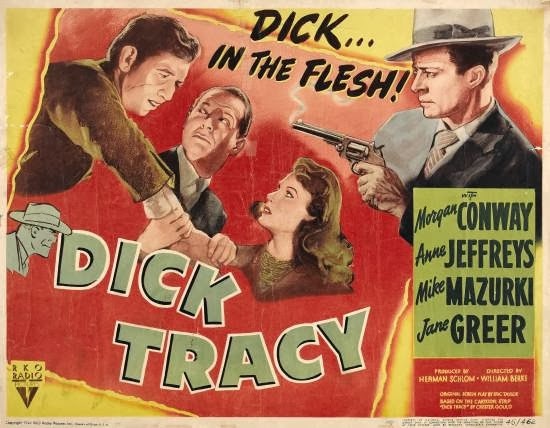
"Dick Tracy" by William A. Berke (1945)


Dick Tracy might have been very popular phenomenon in its time, but this comic strip is mostly forgotten nowadays - if not for Warren Beatty much later, it might have been completely obscure as artifact from another time. Than again, it was the time of radio and all sorts of movie serials about police detectives, generally filmed on a shoe string in a studios, so this was fairly obvious idea. 

The beginning of five-movies serial, "Dick Tracy" is surprisingly unoriginal little story, full of every police detective cliché in the world - I understand that this is just a screen version of a popular comic strip, but still one would expect just a little more excitement instead of this undercooked little number that feels very much like some TV episode. Tracy searches for a maniac mass murderer who apparently kills people with no connections between them and there is a blackmail involved - other characters are just a comic sidekicks: pretty blonde girlfriend Anne Jeffreys, clever little boy Mickey Kuhn, clumsy policemen and such. By far the most interesting are antagonists Mike Mazurki (as mysterious "Splitface") and fascinating Trevor Bardette playing spiritual medium hovering over his crystal ball, one almost wishes they got their own serial instead of Dick Tracy who for all RKO Radio Pictures efforts just don't appears very original or interesting - although I generally love old 1940s black & white detective movies and their specific language, this one comes off as a very uninspired period piece that don't invite for watching of further sequels. 


"Spavaj cvijete moj" by Mahir Paloš


I have discovered Mahir Paloš while going trough 1970s recordings of old pop festivals, where he competed amongst other artists on Split '74 - this venerable music institution generally supported and favorited local stars, but often used to welcome guests from other corners of the country and although in this company Paloš never had a real chance to win any awards, he did intrigued me as exceptionally mellifluous voice (similar to young Mirko Cetinski) so I decided to do some research. Apparently "Jugoton" was intrigued as well, because they released the LP album soon afterwards and this is the one tailored specifically for him.

The biggest surprise is that the whole material was written by wonderful singer-songwriter Kemal Monteno who was at the peak of his powers at the time and in fact, Monteno was very busy man, serving hits for the half of Sarajevo. Not only that he wrote material for others, but he also possessed one of the most recognizable, sweetest voices in the business so naturally, it was impossible to sing the whole album written by him without sounding like him. Not sure was this good thing for Paloš, because unintentionally he ends up being carbon copy of someone else but material is sure impressive as Monteno was incapable of coming up with something half-baked - its very possible that "Jugoton" formally engaged him as songwriter for this project and he was so talented that this could easily have been released as his own solo album. From beginning to the end this is pure Monteno collection, with almost identical voice using absolutely same vocal mannerisms so although it might sound little confusing at first, its a godsend gift to any fans of this great singer-songwriter. Producer Stipica Kalogjera wrapped everything is pleasant, radio-friendly mid-1970s schlager pop cellophane and even if the singer didn't manage to step out of composer's shadow, final result is a very warm, heartfelt collection with a recognizable touch of Italian canzone that was Monteno's speciality. If you love Monteno, this is a wonderful surprise, like discovering that he had a twin brother.