4.3.18

"Hiljade balona i poljubaca" (1961) EP


Together with "More, mandoline i muzika", this little four-song EP basically introduced current (1961) biggest hits from legendary Italian San Remo pop festival. In future, some artists would actually record the whole San Remo-themed EP recordings themselves, but for now "Jugoton" was content to release this kind of compilations. 

Where on "More, mandoline i muzika" stately ballads had new Croatian lyrics written by Mario Kinel and classy orchestrations by Bojan Adamič, the atmosphere here is decidedly upbeat (the back cover actually instructs listener which song is tango, rumba or cha cha cha) and arranger is another Slovenian, Mario Rijavec who makes everything sound very happy, cheerful and extremely enjoyable. This time, Kinel is not the only lyrics writer, a chance is also given to Đorđe Marjanović and Arsen Dedić (both budding singers themselves) while singers are very enthusiastic indeed: everybody savours uptempo, dance numbers, which must have been a complete change from weepy ballads of the day. Lively Marjana Deržaj and Emir Altić gave all their worth to emulate Mina and Adriano Celentano, while otherwise moody crooner Dušan Jakšić lets his hair down in genuinely irresistible cha cha cha. The best of all is the sound of 18 year old Zdenka Vučković who sounds as everybody's favourite baby sister and who will eventually became first homegrown true pop star of entire decade. It is a wonderfully eclectic, uplifting little recording and naturally completely forgotten today. Definitely worth searching for and it can be found as digital download in "Croatia Records" archives. 

"More, mandoline i muzika" (1961) EP


In the late 1950s and early 1960s, local homegrown pop music was all about San Remo and Italian artists - for variety of different reasons, seems that government discouraged decadent sounds from the west but accepted harmless Italian crooners. Reading about the lists of objections (nothing too fast, too slow, too melancholic, too happy) one wonders how did people went around it - well, it seems that covering San Remo hits was the logical answer and influential music editor Mario Kinel somehow managed to serve all these recordings under explanation that they won in Italy and were therefore, proven quality.

Kinel (who else) naturally stands behind this project, which is a four-song collection of hits from San Remo '61. It is all done in version of local artists who carefully and extremely cautiously (some would say, almost trembling from a sheer respect) croon white-glowed ballads originally done by giants of Italian pop music. Lyrics are all done by Kinel and the stylish orchestra was conducted by Bojan Adamič - it is naturally very tame but actually incredibly charming and genuinely classy, since Adamič paid close attention to originals. Singers are all excellent, perhaps the biggest surprise is young Gabi Novak (whom Adamič just recently discovered as she was singing in some TV cartoon) with her sensual cover of lovely "Il Mare Nel Cassetto" - in original, it was a showcase for thundering voice of majestic Milva but Novak gave it completely different, softer sound and as at this time she was still singing novelties, this sophisticated ballad was probably a revelation. Both Marko Novosel and Vice Vukov are such high calibre talents that they could easily stand next to their Italian idols. Next to them, veteran Ivo Robić sounds a bit outdated but he was in a fine voice, even though his particular style hardly changed at all since 1945. 

"Isplači suze" by Tereza Kesovija (1962) EP


Another discovery from digitally remastered archives of former "Jugoton" (now "Croatia Records") is this little EP recording, the long unavailable and in light of her later success, mostly forgotten early, tentative studio debut. Kesovija eventually rose to prominence but it took her a good decade to find her style, which makes this recording even more interesting.

At that time, in the early 1960s local pop music was strongly influenced by San Remo and Italian artists, so like almost everybody else Kesovija covered Mina and Milva, even if this was actually not suited for her voice at all. Ubiquitous mastermind Mario Kinel, who himself idolised Italian music and encouraged homegrown artists to follow their steps, wrote Croatian lyrics for all the selections here, which were naturally covers - the theme of the project was crying and tears, hence the title - orchestration and arrangements (courtesy of Nikica Kalogjera) are stylish and competent, but it must be said that (just like majority of local pop recordings) this sounds as something that could have been done in previous decade and have nothing to do with than current international trends. Considering that 1962. was a year of "Telstar", Duane Eddy, Chubby Checker, Everly Brothers and The Shadows, heavily orchestrated covers of Italian canzone seems as tunnel vision - either from being overtly cautious not to step or anybody's toes (western influences were still censured) or out of personal liking, Kinel groomed young artists as local copies of San Remo winners, while rejecting Karlo Metikoš because he dared to sing American Rock (famously, Metikoš gave him later the signed copy of his French smash recording). Young Kesovija have already sung on popular homegrown festivals but everything from this era sounds as she tried too hard to lower her voice into wrong key (emulating booming alto of Milva), while her natural voice was crystal clear soubrette type bell. These songs were all wrong for her - the worst offender here being mind-boggling decision to cover "Non, je ne regrette rien" by Édith Piaf where 24 years old singer wrestles with stately funeral march. It is still an interesting oddity, even if its completely false start. 

"She-Wolves: The Women Who Ruled England Before Elizabeth" by Helen Castor


I saw the BBC documentary first - which was excellent - and promptly became Helen Castor groupie, since I love the combination of her passion, knowledge, intelligence and beauty. So it wasn't long after seeing another documentary made by Castor that I decided to actually read her books - the fact that I had already seen the documentary (and was vaguely familiar with the story) didn't discourage me at all - the book is far more detailed and it was joy to read, with Castor's warm personality echoing trough the pages.

Some authors have recognisable voice and Castor is blessed with one - she also has extremely likable personality, compassion for her characters and understanding how their destinies were shaped by historical circumstances. Never patronising or condescending, she makes it all extremely readable and exciting, while making it clear that she knows the subject inside out. It is quite a feat to balance all these facts, dates and documents without sinking into dry academic language (many have slipped on this one, emphasising their research to the point of monotony), or to resist taking sides - when facing gossips and hearsay, Castor refuses to indulge into guessing and simply states that we have no evidence to believe what chroniclers wrote down. Since the history is written by victors, no wonder contemporary chroniclers criticised 12th century Empress Matilda (who, as only surviving child of deceased king had all the rights to the crown) for being arrogant and authoritative - something nobody would dare to mention in front of her father, because she didn't won her battle. "Matilda was facing the challenge of becoming queen of England not in the conventional sense of a king’s partner, but in the unprecedented form of a female king. And kings did not deport themselves with a ‘modest gait and bearing’. Instead, they were – and were required to be – supremely commanding and authoritative, as her father and her first husband had been." On the other hand, Eleanor of Aquitaine showed no meekness or submissiveness whatsoever - she was wealthy, adventurous lioness - but longevity made her outlive almost all the opponents so chroniclers  were forced to grudgingly admire her strength and influence. (Its interesting to note that her power became truly established once she became elderly woman and was accepted as a mother figure rather than young unruly wife who couldn't be controlled by husband)

Eleanor's adventurous life is hard to surpass but the next two ladies come very close to match her in almost mythical, white heat of excitement - Isabella of France dared to overthrow her husband from the throne (and served as potential inspiration for character of Hamlet's mother) just to end her days in relatively comfortable house prison, while the spectacle of fierce Margaret of Anjou (the force behind "Wars of the Roses" that is so complex that is almost impossible to follow) finally losing the battle and being driven in a carriage like some ancient Roman prisoner in a triumphal procession, stone faced and grieving for a dead son is impossible to forget. Rounding the omnibus, Castor eventually finishes with Tudor women who clawed their way to the throne and neatly connects the dots, explaining how Elizabeth I avoided the destiny of her famous predecessors by not allowing any husband or son to eclipse her power. While the book is fascinating in its scope, it actually gave me a taste for reading more about "Wars of the Roses". How anybody actually lived and survived trough those times is really a miracle. 

"The Roswell Incident" by Charles Berlitz & William Moore (1980)


The Facts:
On June 14, 1947 something exploded in the air above the remote farm in Roswell, New Mexico. The government sent army to collect the debris and whatever was left from explosion, while curious locals and visitors were strongly discouraged from approaching the scene. Some guessing was involved but immediately refuted by US government who claimed this was just a weather balloon that crashed. End of the story.

The Legend:
Not satisfied with official press release, in the subsequent decades lots of people came with their own theories what actually happened and with time these theories just grew bigger and bigger until at certain point it seems everybody simply knew this was an UFO crash, with dead bodies on board and government simply decided to do research in secret, in order to create their own space ships & weapons & whatnot. 

"The Roswell Incident" was the first of many books published on the subject and its interesting not because of the subject - which is fascinating but not very convincing - as because of the description how something that has simple explanation can grow into elaborate myth and given enough time, start having its own life. (Come to think of it, something similar to religious cults) Since government quickly hushed the whole affair, people became suspicious and because they were told to keep silent about the subject (for patriotic purposes), they created their own explanations that just got wilder and wilder with time. Its never a concrete witness but a hearsay, rumours and distorted memories of the relatives who can't remember exactly what was whispered in private. This book starts very good but in just a few chapters I got tired of uncredited witnesses, anonymous testimonies and all these stories coming from the people who passed away long time ago. You can actually follow how the story got wilder and wilder with time. It starts with mysterious pieces of material ("not from our planet") and than it ends with dead Aliens kept in formaldehyde, somewhere in secret army hangars. Decades later the truth finally came out - government had to keep it quiet because it was a nuclear test surveillance balloon and naturally this could not be published in the press - hence sharp reprimands from the officials and that is why everybody was told to keep quiet and just forget about it. It could have been better if this was immediately printed and to hell with it, because in the meantime half of the planet became convinced that we keep dead aliens in formaldehyde and nobody can convince them otherwise now, its absolutely fascinating how some ideas become public knowledge and tons of people will have their opinions about them, although the truth is very simple. 

"Murder on the Orient Express" by Kenneth Branagh (2017)

When they heard about new version of famous Agatha Christie classic, my friends wailed "oh no, not another one! who's going to watch that?" and than promptly went to cinema to see it. Even with my initial reservations - after all, I have read almost all of Christie's novels and saw enough adaptations - I became curious so I had to see it. First, let me state here that I love Agatha Christie - I think she was genuinely great master of the genre (although not the only one, allegedly there were other popular authors at the time who got forgotten while her work is constantly in print) and her little chamber masterpieces are still continuously attractive to readers. But the idea that her novel can be splashed on the big screen in this day and age of bug-budget extravaganzas means that unfortunately it has to be somehow pumped-up and overblown, after all, action in her novels is usually limited to conversations around the tea table.


As director Kenneth Branagh is fine, if not particularly original or inspired. Since the story happens in the train, he goes for strange camera angles, filming people from above their heads and so on. Occasionally (like in last scene that he places - for no reason - in a tunnel) the movie looks stunning visually and there are lots of spectacular exteriors while the train rushes across the mountains (by the way, nonexistent, real locations are flat grain fields famous as breadbasket) but here lies the catch: Branagh decided to make visually spectacular piece out of what is basically salon murder genre so its all overblown, even the script meanders around original idea (enough to make me wonder is this the same novel I read), not to mention inclusion of black characters (and policemen) well Christie was elderly lady of her times and she knew foreigners only as servants.

On the positive side, acting is excellent indeed. Its one of the best known ensemble extravaganza and naturally very attractive as a showcase of large group of celebrity actors. Johnny Depp is surprisingly effective as bad-mannered gangster haunted by his past and Michelle Pfeiffer stands out as a husband-hunting hussy, while the rest of the cast keeps very well, including always dependable Judi Dench. The weakest link would be Branagh himself who should just do the directorial work, but he also decided to play Poirot himself. Well, its genuinely impossible to improve on David Suchet but Branagh bravely attempts it and doesn't really come off, he is neither fussy or idiosyncratic enough, in fact he occasionally slides into Shakespearian shouts and exclamations and this is not how Christie describes her hero. At least this is not what I remember, its hard to tell now because these movie adaptations have their own lives and everything gets so distorted that I am not even sure anymore. However, David Suchet is God.

10.2.18

Earliest Arsen

Lo and behold, in the on line digital archive of "Croatia records" (previously mighty "Jugoton") I found two little EP recordings recorded in the early 1960s with my dearest late Arsen Dedić making first steps in the recording business. Strange thing is, previously I had no idea these recordings exist at all and I just assumed he started with that clumsy (and, in hindsight completely inappropriate) cover of "Let's Twist Again" and that "To sam ja" from 1963 was his first solo recording. Wrong! 
A year before that, he was already a member of vocal quartet (vocal quartets were all the rage back than) modelled on bands like Four Freshmen, The Four Lads, The Four Preps and such.


You can find Kvartet Melos on pop festival Zagreb '62 where impossibly young and earnest Arsen sings completely fine main vocal in front of his doo wop guys. Later in life his singing style metamorphosed into completely different, stark and declamatory recitation so it comes as a shock to hear his young and powerful voice, he really blasts full power and doing it perfectly believable. This was time when ancient Mario Kinel had huge power and influence over choice of "Jugoton" recordings so naturally he moulded these newcomers in relative clones of his other successful projects like Duo s Kvarnera or Trio Tividi, in fact he imposed his lyrics on the guys although Arsen was (as time will show) perfectly capable to write his own, superior texts. At this time he was still doing it under pseudonym Igor Krimov in order to hide his moonlighting from Music Academy, although having picture on the cover probably blew away the disguise anyway. The music recorded here are mostly international covers inspired by above mentioned vocal quartets, which even than in 1962. was old hat - doo wop was basically thing from previous decade - but for the local music market this was breath of fresh air. On cover of "Lady Is The Tramp" guys swing like mad and Ljubljana Jazz Orchestra actually sound genuinely inspired. You would never in a million years think that Arsen Dedić could swing, but here it is. 


Not long after his dabbling in vocal quartet, Arsen went solo and this is something I only discovered recently. This little, completely forgotten, four-song EP recording preserves his earliest sound and the way he was when he first stepped on a music stage. Still very far from the chanson he will perfect later, these are lovely, lilting little pop ballads (with one exception international covers) and even if everything sound old-fashioned and very quant nowadays, the best thing about recording is Arsen's voice - he was really fresh as a rose back than and his young voice was impossibly attractive. Besides singing songs by Henri Salvador, Domenico Modugno and Gilbert Bécaud, the one and only homegrown number is a funny little country song by Vili Čaklec. Lyrics are written by Arsen himself, still hiding under pseudonym Igor Krimov (but his real name on the cover?) and its just amazing how this recording was never compiled or saved anywhere, it is completely obscure and even I never heard of it until recently. Even though later in life he had built amazing body of work, I perfectly understand listeners who preferred his old 1960s music (something that apparently annoyed him as he constantly focused forward and to future projects). Wonderful gift for fans and collectors. 

"King Solomon's Mines" by Sir Henry Rider Haggard (1885)


As I am getting older, it gets more and more obvious that I can't possibly read all the books in the world (or see all the movies there were made, hear all the music recorded, etc) - the fact that gradually gets even more complicated as with the passing of the time I realise what I remember are simply impressions, how certain pieces affected me, so occasionally I go back and re-read old favourites, just to find them completely different than the first time around. However, I do my best to discipline myself into checking out what I perceive is important, even though I am vaguely familiar with the titles in theory. The perfect example is this fantastic old adventure classic that in reality I have never read before - I knew about it, I knew the author, but somehow it never came my way. So the time has come. And I needed a break from what I was reading previously.


Old and rusty it might have been, but "King Solomon's Mines" is still a powerful, magical experience that keeps the reader's attention some 130+ years after original publication. Literary ancestor of every Indiana Jones-like character who came afterwards, it follows adventures in exotic lands (in this case, heart of Africa and certain Kukuanaland), it bursts with action and is filled to the brim with genuinely thrilling, unforgettable scenes. Some might object to outdated colonialist attitudes of the time but please do take in account the historical context, when exactly novel was written and you understand that Haggard was not half as racist as people today claim - in fact, he divides his characters not so much between the colour line as between heroes and antagonists. Black warriors are noble, strong and brave, while some other characters are deliciously scary and stay carved in our memory long after we finished the novel.

Interesting thing is that supposedly main character Allan Quatermain is not really a hero here - he just happens to be the person narrating the story, but for all purposes he is simply a accidental addition to adventure (search for a missing person who disappeared while searching for King Solomon's Mines) - often, in the middle of the fights he would duck, curse and hide, while his fellow companions would do the physical part. In this, he resembles mythical Odysseus who had brains, while others used brute force. Initially the book rubbed me all wrong with its description of elephant hunt - but once I got over what was perfect Victorian fantasy, the things really start cooking and eventually I got completely swept away into witch hunters, elaborate fight scenes and dark mountain tunnels. The farewell between heroes and Umbopa was very well written and it got me even a little bit teary.

"Go now, ere my eyes rain tears like a woman's. At times as ye look back down the path of life, or when ye are old and gather yourselves together to crouch before the fire, because for you the sun has no more heat, ye will think of how we stood shoulder to shoulder, in that great battle which thy wise words planned, Macumazahn; of how thou wast the point of the horn that galled Twala's flank, Bougwan; whilst thou stood in the ring of the Greys, Incubu, and men went down before thine axe like corn before a sickle; ay, and of how thou didst break that wild bull Twala's strength, and bring his pride to dust. Fare ye well for ever, Incubu, Macumazahn, and Bougwan, my lords and my friends."

Well, I'll be darned if this was not excellent and very powerful, specially if you previously went trough everything they went together. It is really unforgettable and I perfectly understand why this basically old adventure novel continues to live on, because Haggard (who was far from haggard, looking as some adventure hero himself) somehow managed to write genuinely thrilling adventure with timeless quality. And I love the novel's dedication: to all the big and little boys who read it. Which I found very affectionate and true, because of this I loved the novel even before I start reading it. Just a perfect, perfect escapism. 

"Bolen leži mlad Stojane/Mi se sobrali dvanaest drugari" - Macedonian Folk Music (1958)


While I'm still on a roll with various ethnic music from different parts of former Yugoslavia, I decided to check music from Macedonia.  Now, although Macedonia is definitely very far away from where I grew up (spiritually and geographically) the sound of the language is actually somewhat close to my heart because I have spent twelve months of National Army Service there so kind of get the idea of phrases and even music. (You hear very close sound in nearby Bulgaria, which to my understanding is centre of bitter dispute among neighbours) In any case, I always liked Macedonian music so this little single was just a perfect gift from me to me.


Side A has duet Vaska Ilieva and Nikola Badev in traditional Macedonian folk ballad - guy is fine but lady is extremely idiosyncratic (to put it nicely) and even though Ilieva seems to have been highly regarded in her homeland, her strong, nasal wail might be acquired taste. Here she was actually still very young and sweet, on some later recordings she really goes strident. Side B has another traditional folk song but this one was recorded by almost-operatic Blagoj Petrov Karađule who had truly magnificent voice - it is perfectly authentic vocal as it should be, with thrills and frills that demand strong control of vocal chords worthy of any opera house. Of two sides B would be my preference for the simple reason that I truly enjoy singer's voice much more. Both songs have very sophisticated, semi-classical background that might not really be authentic (my guess is that some conductor or the other decided to make it more classy) but everything sounds perfectly fine.

"Pjesme I Plesovi Naroda Jugoslavije - Kosmet" (1959)


Carried away with my sudden enthusiasm for old "Jugoton" archives, I continued my musical research with this 1959. EP recording for no other reason that I am vaguely familiar with music of other parts of Ex- Yugoslavia (each "Songs and Dances of Yugoslavia" recording covering a particular area) but honestly have no idea what kind of music they have in Kosovo. So there you go, where no man has gone before. 

Released in 1959. under the title "Pjesme I Plesovi Naroda Jugoslavije - Kosmet" ("Songs and Dances of Yugoslavia - Kosmet") this compilation was probably amassed from tracks already recorded previously by local folk artists. The cover picture shows male vocal trio dressed in traditional folk costume and this is perfect description of the music inside the package: rough-hewn, lilting, soulful and somehow yearning under the surface, despite strong rhythms. Since I was born in completely different part of the country and don't understand a word, this could all be from the Mars but I approached it all as an interesting music experiment and immediately noted certain similarity with music from nearby Macedonia and Bulgaria - its easy to imagine this as a kind of village dance music because each song has sinuous rhythm accented with dazzling drums and quite virtuosic accordions. The first thing you notice are singers and their strong, wailing voices but I kept my attention on excellent backing musicians who are really very good, in fact personally I enjoy some of these players even more than featured singers who are probably perfectly authentic but sound a bit harsh to modern listener. Ladies are also represented - Manakovska Gonđa and Pakaštica Behiđa - who are naturally much sweeter-sounding than their male colleagues, though their high-pitched voices remind me very much of music from India so its very interesting to contemplate how such strong Asian (Middle Eastern?) influence came all the way to Balkans. It is probably not something I will listen very often but its quite eye-opening (ear-opening?) and obscure enough to appeal to me.

"Slovenske Narodne Pjesme" (1956)


Browsing trough enormous archive of former recording company giant "Jugoton" (now "Croatia Records") that is now available on line, I was intrigued with series of EP recordings released roughly from mid-1950s to mid -1960s under the title "The Songs and Dances of Yugoslavia" ("Pjesme i plesovi naroda Jugoslavije"). The homegrown recording companies were still in the earliest stages, so they experimented with everything in attempt to find the audience and titles of releases perfectly describe this technique: little bit of folklore, classical, brass orchestra and pop schlager, peppered with occasional international hit. This particular series had actually interesting context as to showcase various music traditions from completely distant parts of the country, so each recording would focus on separate areas, like Bosna, Kosovo, Dalmacija, Vranje, Vojvodina, Pomoravlje etc. Occasionally the arrangements went too much into semi-classical direction (in attempt to make traditional folk music more legitimate, I guess) but for the most part things were kept simple as they should be.

This particular recording - which I actually bought on line and was surprised with crisp, clean sound of original mono 1950s recordings - showcases traditional folk music from Slovenija. The mountainous area, graced with beautiful lakes and Alps, was at the time northern part of Yugoslavia and naturally has its own, recognisable music that leans toward either sprightly Polka or a cappella vocal quartets, both represented here. The recording is divided between two sides - side one are lovely, cheerful duets between Danica Filiplič and Franc Koren (with energetic accordion), while side two are somber a capella numbers by vocal quartet Fantje Na Vasi which sounds timeless (listener can easily imagine this type of music being performed two hundred years ago). Since I was already familiar with opening song (lilting "Petelnička Bom Vprašal") on the spur of the moment I decided to buy the whole compilation and its delightful. The best thing about it is that producers decided to keep it simple and authentic, instead of adding layers of symphonic strings and operatic singers, this is local equivalent of Alan Lomax and his field recordings. 

Heavenly bookshops & libraries

As someone who was born with a love for books, I always imagined Heaven as a beautiful, large bookshop. Recently I discovered some photos of pretty awesome bookshops and libraries that really thrilled me more than I can say - I couldn't care less for the architectural grandeur of some sport arenas, shopping centres, cinemas or whatnot but when it comes to bookshops, this is something I truly love and admire with all my heart.


The first one is in Buenos Aires and its a hundred years old theatre called "Ateneo Grand Splendid" - yes, its an old theatre building transformed into incredibly beautiful bookshop (it was a famous Tango venue, with performers like Carlos Gardel singing there), at certain point theatre turned into cinema with a live orchestra playing music background to the silent movies (sound wonderful) and with time the financial burden of maintenance of such building led to place being sold and now used as a bookshop. The architects intentionally decided to preserve the elegance and beautiful atmosphere of the place, so the curtained stage now serves as cafe, while the previous audience spot is now an impossibly beautiful bookshop. If ever I would have chance to visit such place, I think my soul would sing with joy. Probably out loud.

"The Klementinum" is in Prague - therefore much bigger possibility to ever visit the place - and its now a  National Library of the Czech Republic. It started as a 11th century chapel that grew into Jesuit college and eventually the massive book collection became National Library. The collection is still a work-in-progress and it will apparently get new, modern space elsewhere but for now the most famous part of it is The Baroque library with painted ceiling and just looking at it made my heart flutter with excitement. If I ever go to Prague again, this will definitely be a place to visit and to treat myself. Even if I don't speak a word of Czech, just to be there and to soak the atmosphere will be enough. 

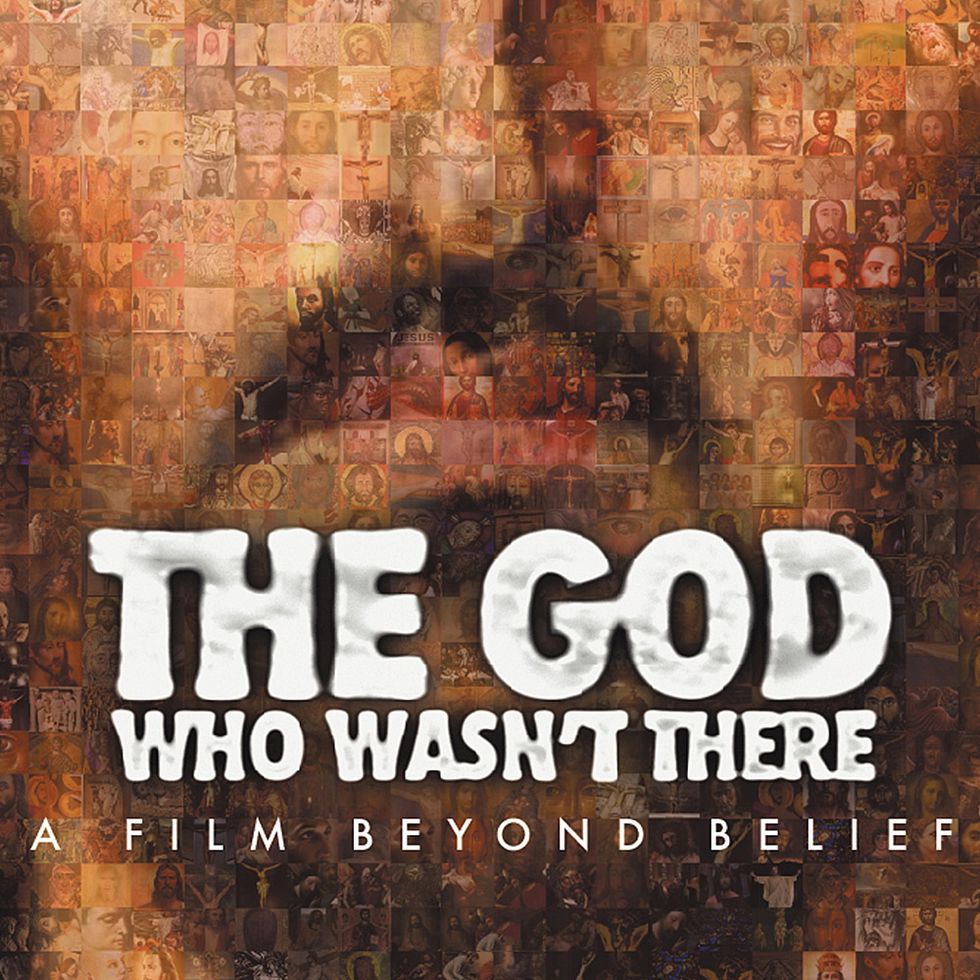
"The God Who Wasn't There" by Brian Flemming (2005)


What initially seemed as something right up my alley - the Christ myth theory and possibility that the historical Jesus Christ was amalgam of different people trough the previous centuries - soon ended up as a very unenjoyable documentary. And all because of director's heavy handled, aggressive approach that I didn't care for, in fact it was quite obvious that he has an agenda and it slowly became infuriating. No doubt Brian Flemming probably see himself as a warrior for truth and let him think so, but please, let the other side finish their sentences and let them talk first, instead of taking the words out of the contest and portray everybody as a dangerous madmen. 

In theory, what Flemming claims here is more or less exactly what I think - that religion started as human attempt to explain natural forces (thunder, lighting, wind, rain, eclipse, etc) and trough time each culture elaborated previous stories until they got to certain religious laws and rules. That's all fine. I am even fine with explanation that Christ as such probably never lived, although this might be a bit far fetched - as Bart. D. Ehrman points, while its true that we have no physical proof or even contemporary witnesses, we don't have them for Pontius Pilate as well (we only found one stone with his name carved in 1961) - we can't simply reject the possibility that some ancient person actually lived because we have no physical evidence for it. What I found completely tasteless and wrong is the way director Flemming hammers his opinions against perceived enemies (believers) by distorting what they say, cutting the video clips to suit his agenda and basically making everybody looks like unhinged. Everybody can do that and its obvious - instead of letting his interviewees talk, he select only few sentences and points "HA! You see what a religious fanatic they are!" while at the same time giving much more space to fellow activists who are permitted to talk in length about opinions they share with the movie director. He even goes back to inquisition obviously equaling everybody who is religious with centuries old torturers. Since the documentary basically preaches to converts anyway, it is very strange that someone who is agnostic, like me, actually felt embarrassed to watch how Flemming treats his interviewees - attacking everybody head-on without letting them express what they think is just completely wrong and one sided. I particularly felt bad for a principal of Christian School who was obviously completely decent, soft-spoken and well-mannered person being tricked into the interview where Flemming was just mindlessly attacking him. This was not Flemming's intention but the movie left me with more compassion towards fellow people, no matter what private religion views they have. As for Flemming himself, I don't want to know about his life or work anymore, he obviously carries some personal issues that fuel his stone-throwing and if you think this is activism, think again - he might accuse others of being fanatics while not seeing himself in the mirror.  

"Sirius" by Amardeep Kaleka (2013)


Back to UFO conspiracy documentaries and this one explains the mission of Steven M. Greer much better than what I have seen previously in "Unacknowledged". Say whatever you want about any possibility or a theory but when its presented nicely, with professional editing, camera and proper cellophane, it can at least made you think (or re-think) about what is your position towards the subject. It really all comes down to what are you prepared to accept as possibility instead of accepting the dogma.

Steven M. Greer is a modern day Don Quixote who had invested majority of his life to research about UFO and alien visitors - its a fight with windmills and quite ungrateful task not unlike the one by mythological Sisyphus (eternally doing something futile), but along the way he amassed equal amount of people who ridicule him and those who take him seriously. Greer's explanation is that government constantly suppress knowledge about alien visits (for their own agenda) and purposely use media to anathematise any witness as a loony. So far he is right - anybody who just mentions unexplained lights and fast-moving formations in the sky is exposed as a nutter and majority of people rather keep silent than to become a joke and lose professional standing. In some cases (like Phoenix lights) there are actually thousands of witnesses so its rather infuriating when major of city pokes fun at all of them - just to quickly apologise afterwards and retract his statement (?) - in my personal opinion, this is not a case of some paranoia or conspiracy but a natural human curiosity. What are these fast-moving lights in the sky and why nobody can properly explain their origin, when obviously they are not coming from army or commercial flights? As Greer points, lots of pilots and people employed in the government services were simply told to keep quiet about it or else they might lose their jobs - Greer actually went so far to arrange press conference with large group of retired pilots and officers who all gave formal testimony about what they experienced and how everything was hushed. Just when you would expect government would issue some public statement about it, 9/11 happened so naturally the focus of attention went elsewhere. (The documentary suggest, intentionally)


One of the most fascinating aspects of documentary is story about tiny skeleton found in Chile (so called Atacama skeleton) that obviously and very apparently doesn't look like anything we know coming from human race. Researchers who worked with its DNA are unwilling to state the obvious, so they fiddle diddle with the concrete answers and talk about possibility of some unfortunate birth defect - and the creature lived way after the birth, so where and how did it lived than? It really appears alien so there are only two possibilities: either is a complete fraud and carved from some material (it is not, it has DNA) or its not from this planet. But mention this and you risk being publicly ridiculed in the media.


Greer and his followers believe that we can invite aliens with peaceful meditation so they experiment with the energy and sit under the night sky humming the mantras, but this kind of sound too improbable to me, although it shouldn't actually as perhaps we posses some kind of living, spiritual energy that connects each of us with the universe. Well, its quite fascinating subject and I enjoyed the movie - it made me think - although unfortunately it focuses only on one part of the world so one needs to take in account the possibility that much bigger things (contacts?) already happened elsewhere.

2.2.18

"Medieval Lives: Birth, Marriage and Death" by Helen Castor (2013)

Far more enjoyable, enlightening and informative than paranoid UFO theories was three-part documentary "Medieval Lives: Birth, Marriage and Death" created by redoubtable Helen Castor. I purposely use the word "redoubtable"  as in "impressive" because I am quite smitten with Castor - not only that she is a Historian, driven by intellectual curiosity and has a gift to inspire enthusiasm in her audience but she is also a very attractive lady with a warm personality, which for me is quite powerful combination (brain + looks), to be honest I might be a little infatuated with Castor - I saw her already in a documentary titled "She-Wolves: England's Early Queens"  which was very interesting, right up my alley and apparently Castor knows what she is talking about, she seems to be quite expert on medieval England. I seriously started considering to read some of her work.


In "Medieval Lives", divided in three parts, Castor explains that trough the description of three main stages in life (birth, marriage, death) we can explain person's attitude to life and so she goes on to examine how people in medieval England went trough them and what were the traditions of the times. In each episode she also consults experts on certain themes (a midwife, a priest, etc), while lovingly referring to her two decades long study of private correspondence of certain  Paston family - these letters are the oldest private correspondence in the English language - trough birth, wedding and burial documents Castor examines not just members of Paston family but how people back than lived in general. It is absolutely fascinating - when it comes to birth, for example, only women (read: midwifes) were allowed in a warm and cocooned room, while church and priests were basically only meddling in with their clumsy instruction books written about the subject, but as Castor explains, rules were one thing and the reality another - in a real life people often ignored the rules. When it comes to marriages, it is quite interesting that people initially didn't care for church weddings - that came later - initially people could just agree to get hitched verbally anywhere they felt like it, be it a pub, a cornfield or wherever. My guess is that it was usually followed by roll in a hay and probably forgotten soon afterwards so maybe this is where church came in, to make sure people take their obligations and responsibilities seriously. In cases of aristocratic families, girls were often promised (and often delivered into a marriage) at the extremely young ages - not only that this don't appeal to our current, modern sensibilities but even back than people didn't approve of it themselves, because such young girls often died during childbirth or were later in life incapable of pregnancy ever again. Famous Lady Margaret Beaufort (grandmother of Henry VIII) was one of those child brides and not only was she sent away to her husband at the very tender and vulnerable age of twelve, but the husband died soon afterwards (from plague). When almost identical situation occurred with her granddaughter, imperious old lady strongly disagreed with it and refused to send the young girl in potentially disastrous marriage. As for the deaths, money was often given to churches and monasteries for prayers and masses to be said in the future - we are talking about huge sums of money - which judging from our current perspective is somewhat pointless, kind of throwing it in the wind - but back than people really took this very seriously and wanted to be forgiven for their sins & probably hoped for some immortality, oh well. Not only that I really like Castor but I enjoyed the whole subject very much and it made me wonder how would future generations (in few hundred years) look at our lives and comment how barbaric and ignorant we used to be.