20.6.23

Amsterdam - Open Garden Days

Once a year, one particular weekend in June, houses located on beautiful canals of Amsterdam are opening their doors to public so people can admire private gardens usually hidden from a view. Even though most of them are museums now, the gardens are still not usually available to visitors - so this is a very special occasion and a chance to see something different, something more personal. 


"But how do people feel about opening their doors to so much intrusion?" I asked a friend. "Most of them don't mind" he said "in fact, some of the people quite welcome the visitors and the attention. You must understand that people live very lonely lives and having curious visitors checking out their gardens is actually a welcome entertainment." We both agreed that in private houses we will behave and will not swipe the dust with finger in front of our hosts. There were some house rules (no backpacks, no bags, no pets, etc) but nothing that I would find unusual and in front of each house there were some young students marking our map, each house had a different number on a map and you will get cross or a fish or a heart on each location. We did all of them, this year 25.


What strikes me the most is a tranquility in these gardens - they are in a historical centre of Amsterdam but so well hidden from the streets, mostly as a part of the inner courtyard - that you feel as slipping into another, magic world, far away from the city. While each single of these gardens have their own identity, I have discovered that the little ones, that belong to private families are by far more attractive than the large gardens that are part of museums and therefore somehow generic. 


26.5.23

Anna Mae Bullock (1939 – 2023)


Shocked and heartbroken as I was when hearing about the passing of my beloved Tina Turner, it actually took me a while for this to sink in - initially I was just surprised (and don't even know why, since we all knew she was sick and fragile, so this was inevitable) because she was such a symbol of vitality and strength that in my mind she was supposed to go forever and stay immortal. I genuinely expected her to live to hundred. The full sadness hit me the next day when I cried the whole morning and was so distracted that I went to work leaving my keys and phone at home. While the tributes of love, admiration and support are coming from all over the world, I am thinking how interesting is that this lady touched so many lives around the world and people feel genuinely moved by her passing. It is a testament to her charisma that this is not just another celebrity death but a passing of a genuine icon.


Like so many listeners of my generations, I was vaguely aware of Tina from 1970s (I was too young to remember the first half of her career) but witnessed her 1980s explosion and to this day I remember where I was and who was with me, as we saw her strutting her stuff on MTV, proud, sexy and strong - nothing like teenage pop stars of the day, this was a true warrior queen. Everything about her was unique and there was absolutely nobody else like her around - somehow she turned all her characteristics into a weapon and the fact that she was middle-aged, black and raspy-voiced, well it was all part of the package. You could hear her amongst ten other voices and even with eyes closed you knew it could only be Tina. During my formative years, when my head was buzzing with current pop stars, she was a Northern light for me, I celebrated and revelled in her triumph, apparently the millions around the world felt the same because people truly loved her success in spite of adversity. 


I collected posters and newspaper cuttings with her pictures. I collected VHS tapes with her live performances. Eventually I discovered the huge recorded back catalogue that introduced me to 1960s soul and chitlin circuit, the golden era of soul music and many other musicians who where there. To get her autobiography, I traveled to another country just to order it and than travelled back to collect it. I have witnessed her live in concert three times in three different countries (and somehow got missed the fourth time, which I still regret). I loved everything abut her - her laughter, her earthiness, her openness and charm each time she spoke and you could tell she was a gracious person. When internet came along, it became my almost daily routine to always check Tina Turner on youtube, something that always uplifted me and put me in right mood - it was like a shot of energy, where others would have a drink, I would watch Tina and click my fingers. 


After two days of serious moping and mourning, today suddenly it hit me that I can't listen her music and feel sad - everything about Turner is uplifting, celebratory and exuberant. Because her music was extension if her personality - Tina was ball of energy, she loved life, she loved to laugh and listening to her music is always "joie de vivre". And I am loving the fact that millions around the world - grieving and mourning her passing - still understand that Tina Turner was always about the good mood, spark and light, they celebrate her gift to this world and fire she gave. Farewell my beautiful lady, I loved you always and will for the rest of my life. 


24.5.23

Exhibition: Juliana's century


Before I forgot, I must mention a quite beautiful exhibition that was on display in Amsterdam's De Nieuwe Kerk and it was about Queen Juliana, one of the many royal links in the chain that led to a current king. Since I am a foreigner here, it was very interesting for me to learn who exactly these people are - other visitors are naturally familiar with them, me not so much - apparently for a few generations it was always the females who inherited the throne, Juliana being the only daughter of Queen Wilhemina and later succeeded by the daughter Beatrix. All the material on display came from a personal collection of the royal family so we were treated with really interesting photos, costumes, mementos and memorabilia that described the life of young princess as she grew into adulthood.


Old photographs are showing stunning similarity between different generations of women in the family - there are quite a recognisable, distinct features connecting all of them and I can even see these features going further to a present royals. I have noticed young Juliana looking quite gloom and somber trough her youth, but she did cheer up once she got married to a German prince with whom she had four daughters - it was Juliana who with her family lived in Canada until the end of WW2. You must locals to tell her more about her, I learned that she was basically a very much loved queen and often snubbed the protocols, insisting on simplicity and humanity. 


This exhibition was inspired by the anniversary of her inauguration and provides a historical context of the times when she lived, along with a refreshing portrait who she was as a person. I was particularly taken with a little miniature portrait from her student days and really loved it. In fact, went to see it even twice. 


22.5.23

"Love to Love You, Donna Summer" by Roger Ross Williams & Brooklyn Sudano (2023)


A brain child of director Roger Ross Williams and actress Brooklyn Sudano (real daughter of the singer), this was supposed to be a genuine, warts and all portrait of a famous disco queen and the stark contrast between her public and private persona. If you ever had any passing interest in Summer - and she was, frankly, unavoidable at certain point, where her double albums were selling in millions and topping the charts - you are probably aware that she was uncomfortable with her sultry image and contrary to her success, could not wait to escape disco, embrace religion and strive to some imaginary validation, which unfortunately also means antagonising the very same audience that loved her and made her a world success. These are very known facts, often covered elsewhere and millions around the world are familiar with the story - therefore, a documentary might serve as a perfunctorily introduction to a new generation who has never heard of her and who might delve deeper in her recordings, but older fans know all of this. It seems this is what documentaries nowadays do, they rehash old stories and re-package them with some new scandalous twist, to make it more interesting. Next generations will refer to this documentary as a point of reference. 


I kinda expected a storm in a teacup and this is exactly what it was. We go trough Summer's childhood, Germany, "Hair" musical, first scandalous disco hits, Giorgio Moroder, than singer's growing distaste for everything that her success represented - sexy image, hedonism, disco clubs, etc - and eventual insistence that she is not like that at all, rejection of the whole genre and its audience, vicious homophobic remarks and their denial (I don't believe the denial). Because I grew up with her music, I was very focused on this documentary but slowly it started to annoy me, I clearly saw it for what it is - an apology to her fans who supported her and were crushed when she turned openly against them. By creating a documentary where the main character is unhappy and haunted, its expected it would somehow make it easier to swallow. No, the documentary just makes her superficial and ungrateful for success she had. 


Let's start with a daughter Brooklyn Sudano who is often shown rummaging trough her mother's scrapbooks, awards and LP covers as she is some kind of Indiana Jones who has now for the very first time discovered that her mother was a superstar. She is looking at these album covers like "oh wow, I didn't know she was so famous" - please. There is also a family, as expected a typical church going Boston family who was ashamed of her chart smashing hit single "Love to love you baby" and while this obviously bothered artist herself, the family quickly learned to enjoy her wealth and success. As expected, Summer often complains that she is not a sexpot at all, than there are stories about abusive partners, attempts at suicide, how unhappy she was all that time and we got the strange feeling that she rejects the very success that she strived for - leaving a divorce and a first daughter behind, where she could focus on career, than she moans about the career. The breaking point for me came when she complained that recording company dismissed her request to hold on with release of latest Streisand duet until her own "Dim all the lights" grows to number one - eventually the Streisand duet went to nr.1 and "Dim all the lights" was only number two. It was a huge year for Summer and having two singles on top of the charts was not something to ignore, however the documentary makes it sound as it was evil and greedy recording company that stabbed her in the back and did not listen to her wishes. In reality, a petulant stance from someone who obviously lost her compass.


Documentary somehow totally ignores everything that happened after 1970s - there is a skimpy mention of her turn to Christianity, a tearful press conference where she cries that she didn't mean to criticise her fans and some home footage showing her slowly withering away from cancer. 1980s and beyond simply didn't happen, neither many unsuccessful attempts at come back. They did mention her 1983 smash "She Works Hard For The Money" but mostly as a example how far her image had cleaned up and subsequently how less interesting she became. A disco queen who actually don't like disco, rejects her gay audience and wants to be known as a serious (& religious) artist is just not so appealing as a sparkling, exciting artist she once was. I will always love her early albums because I grew up with them but this documentary just left a sour taste in my mouth. I hope that future generations will not whitewash that Summer rejected the very audience that build her up. 


20.5.23

Eurovision Song Contest 2023


The biggest TV event of the year is behind us now. For all the smirking and criticising that Eurovision is 

uncool,  it was the most watched Eurovision in the history of this programme and BBC had reported that 63% of the total TV audiences watched grand finale. It feels like every year it attracts new generation who is not familiar with it and every year people get upset by voting system, rules, etc. Well it is what it is - entertainment show with a huge history and of course its not the same as before (the most notorious complaint) because the music industry is changing and current performers are like gladiators in arena. One interesting thing that i have noticed is how spectacle itself almost completely eliminated the music - now its all about being noticed and catching everybody's attention during a few minute performance - just standing there and singing will not do, to be remembered in such competition, an artist must preferably swallow a burning torch or strip naked or do something extra unusual. And so it goes. 


I couldn't be bothered with semi-finale but was genuinely excited about big finale on Saturday night. Immediately I noted that performances this year are competing who will eclipse who - anything we have previously seen only in video clips is not possible to do live on stage, including a totally SF act by Norway and allegedly huge favourite Loreen who rolled between two giant spaceship screens and was basically alien from another planet. It had absolutely nothing to do with the song or its lyrics but it was very effective and quite unforgettable. Right next to her, shoulder to shoulder was Finland and its manic representative Käärijä who was actually quite good - not my kind of music, but it was something fresh and different. I have also noticed performances by Portugal, France and Italy as they were memorable and stood up from the crowd. Both Portugal and France had a confident, flashy girl singers while Italy sent a typical model looking guy who was better than his song. 


And now to the elephant in the room - Croatia. After years of trying everything and being ignored time and time again (always painfully obvious that local taste differs from wider EU) this time they were inspired by last year's entry of Serbia, which was a highly stylised art performance not unlike something by Laurie Anderson and though it did not won, it gained quite a cult following. Not to be outdone, Croatians decided that this year they can send something completely left-field too and sent punk band Let 3 apparently known for their effective shocking performances - at first, this seemed as such a cheap trick to me, kind of reaction one would expect from someone who was never validated so now decided to show the finger to establishment. But to my surprise, as Eurovision itself settled into circus and one cute girl singer replaced another in perpetual ass wiggling contest, Croatians came in as a very welcome breath of fresh air - they were rocking, they were almost naked (in completely ridiculous, unflattering underwear) , they screamed, they had a blast. And even though they did not win or even rated high (they ended up right in the middle, around 13th place) they left quite a mark - no less than J.K.Rowling tweeted that she loved it and audiences around the world welcomed something outside of the box. 


I must also add that just the day before Eurovision, I have listened the whole list of every song at my work and absolutely nothing registered in my brain - when played in the background, this was just a white noise, overproduced and bland. However, it worked as a visual spectacle. So my conclusion is that at this point Eurovision metamorphosed into something else and perhaps its unrealistic to expect music to be same as back in the day when singers just stood there with hands in their pockets. And let's not forget that even back than, there were some bland and uninspired choices. 


3.5.23

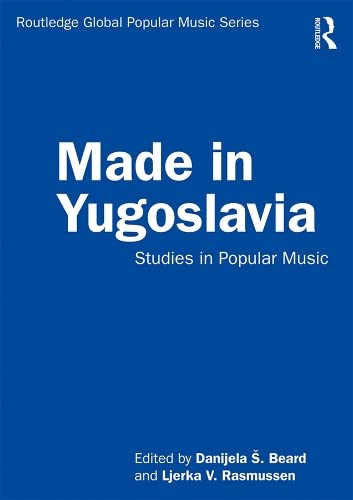
"Made in Yugoslavia: Studies in Popular Music" edited by Danijela Š. Beard (2020)


I have read quite a few books on the subject of popular music in my homeland (as it was back than) but so far they were always focused on pop & rock music - there is this huge discrepancy between what urban centres promoted and what actually is accepted and loved across the whole region. With all my love and respect for works of Petar Luković and Siniša Škarica, theirs was just a part of the story. Even as a child, when I was growing up, I was aware that its only in big cities that audiences actually care for classical music or chanson or anything really urban - step outside of the cities and the whole countryside is all about folk music and its countless variations. We used to look down and snicker at those but the tide has turned and apparently kids today are accepting it in all the seriousness. 


According to this book, the actual sales of gramophone records in 1980s were genuinely reflecting what was the taste of the nation - folk music was almost 60% of total sales, followed by 29% pop and only 13 % of pop music. This is something I always suspected. If you read the magazines, it was all about pop stars and rock music but in reality, this was happening only in the big cities - the rest of the country was all about folk musicians who existed in their own universe and had 0 support from the critics and journalists. And this is why this book is so fascinating and illuminating, because it points not only at popular music - which was already covered elsewhere - but also seriously discusses various branches outside of urban genres - like folk, starogradska, music of Macedonia, the phenomenon of Lepa Brena and even festivals of patriotic songs that were promoted by the regime. 


Because its a collection of 19 different essays (and various authors) at first it appeared a bit dry but soon I was won over by the sheer scope of the subject and how respectful these authors were: without exception, they approached their genres with greatest attention and explained why this matters and when did it happen and how it lead to something else. Every single name here was a link in the chain that created much bigger story and if at times it seems a bit too politicised, its only because I was not aware of it back than - I was a teenager who did not care for the political background of this music - this was a very welcome read and will probably return to it at some point. The whole series seem very interesting as this publisher has a lot of similar titles with introduction to music of various countries. 

2.5.23

God's children: Lady Day going home after the concert 1957.


The full title of this photograph is "Billie Holiday on Broad Street leaving after a gig at the Sugar Hill club in Newark 1957" and here we have a completely natural, random and candid moment where living legend and internationally celebrated Jazz royalty is caught in a second just as a natural, breathing and probably slightly tired human. 


As much as we love to romanticise and admire celebrities (specially dead ones), its easy to forget they were just humans, like any of us - nobody starts with the idea that one day they will be remembered as giants and cornerstones of anything. Most of us are just living day to day and its the people's perception of us what makes all the difference. Billie Holiday herself was long gone and became a myth, our jazz lady of perpetual sorrow - under the layers of beautiful, melancholic music there is a real person buried deep, the old photos showing her fragile beauty, Gardenias and all. Mostly, we see her in the dressing rooms, alone with her dog, on a stage, her life lived between sharp contrasts of expected 1950s comfortable home life and night clubs. Majority of her pictures were posed so this one comes as a refreshing glimpse into a moment, when Lady Day is deep in her thoughts, walking towards the cab, perhaps to her dealer, the stage glamour just a prop, she needs a drink and her feet hurt her. What an excellent photo.

17.4.23

"The Quiet Girl" by Colm Bairéad (2022)


Just a previous week I was celebrating a directorial debut by British actress Rebecca Hall and now i am blown away by directorial debut of young Irish director Colm Bairéad who was born in 1981, so yes, kids are OK and the world is in a good hands. As much as we get hopeless and stressed about the state of the world, there will always be kids who have their own perspective and its wonderful to understand that the future belongs to them. Perhaps this is just as it should be, some new souls uncluttered by our prejudices and ballast.


This lovely, delicate movie is about the young unloved and neglected Cáit (luminous Catherine Clinch) whose huge family practically don't even notice her and when her heavily pregnant mother gets close to giving a birth (again), they pack her unceremoniously to spend the summer with distant relatives she have never met before. Nobody tells her anything about it, nobody asks her about her opinion, in fact during the whole car ride her father hardly even speaks to her. (And he even forgets the suitcase with her clothes) In the new surroundings, at some lovely clean farm, surrounded for the first time with love and affection, Cáit blossoms like a flower and even opens up a bit - its a healing process both for her and for childless couple who now take care of her, even if its just one summer. At the end, she has to go back to her school and her family but we know she will never forget this summer. 


Just like Cáit herself, this is a completely soft and gentle movie from a perspective of a shy, observing child. Because it speaks with understanding of child's soul, we can all instantly connect with her heart, since we were all kids once and know what it is to be surrounded with grown-ups and their coded world. Some of them are threatening (father), some are comical (nosy neighbour), basically Cáit is a child left to a mercy of the world - luckily the relatives are here to love and protect her, even if just for a short period. I grew up in a cold and hostile household where they would also pack me off to a countryside during summer vacation, so this movie spoke to me - it had open some old wounds and reminded me on people long gone. I could watch this again, its quite a unforgettable little jewel.

7.4.23

"Akhenaten, Dweller in Truth" by Naguib Mahfouz (1985)


Yes! I read another book! 

What was just a natural lifelong habit before, became a task now, because my attention has been stolen by too many online distractions - it does not mean I am reading less, but actually my brain is all over the place and I am busy studying Wikipedia, etc. But I promised to myself that I will never stop reading books and must read at least 12 books per year, comparative to months in a year. Years ago I have read "Cairo Trilogy" by Egyptian Nobel prize winner Naguib Mahfouz, and although I don't remember anything about it, I know that I had enjoyed it very much so this was almost like a re-introduction to and old friend. I knew that I would like it. I just didn't know that it would take me so long to plough trough what is basically a slim volume. But I did it, chapter by chapter before sleep. 


I have been in Egyptian Museum of Berlin where famed bust of Nefertiti still amazes and impresses visitors with its timeless beauty. She is truly breathtaking. But just next door, there is a bust of her husband Akhenaten and appropriately, he is all smashed and destroyed as was good old Egyptian tradition of "Damnatio memoriae" and his successors saw him as a heretic and antagonist. Akhenaten himself is one of the most fascinating characters in Egyptian history and deserves much more than to be eclipsed by his wife, who after all, was coasting on his status - luckily not all Amarna art was destroyed and we still have some priceless pieces depicting Akhenaten and his family praying to sun God Aten. It was just one glorious chapter in a long history of Egypt but still remembered to this day, kind of like Egyptian Camelot. And just to prove that human nature never changes, there are literary hundreds of different ways people look at his reign, some see it as a beautiful religious experiment, others as a abomination and break with tradition.


The novel is very much Rashomon-like: a young scribe Meriamun is searching for the truth about supposedly heretic, recently deceased pharaoh and thanks to letters of introduction from his well respected father, he interviews many members of Akhenaten's court - each of them has a completely opposite impression of pharaoh and the contradictory picture that emerges tells more about them than about Akhenaten himself. We never know really what pharaoh is like, since each character has different motivations and ambitions - while some admired him, other despised him, many of them only tolerated his fixation with new religion as long as it suited them, etc. Mahfouz is a masterful storyteller with highly sophisticated style - not unlike "The Gospel According to the Son" by Norman Mailer, we have a specific historical moment depicted in a very delicate, almost poetic way, where atmosphere means more than story itself. Perhaps the only misstep is the last chapter - everything leads to a big finale and when it comes, it felt strangely underwhelming, the novel could just as well be without it. 


3.4.23

"Passing" by Rebecca Hall (2021)


Wow, what an excellent movie! 

My head is still reeling from last night when we watched this - after a sweet and slightly theatrical argument over my preferences towards old b&w classic movies - the subsequent compromise resulted in fairly recent 2021. movie directed by British actress Rebecca Hall in her directorial debut. She is one of those actresses with familiar faces but impossible to actually place - I have exactly the same problem with Keira Knightley, Natalie Portman and Anne Hathaway, I understand its not all the same person but to me they are totally undistinguishable, pretty young faces successful in their domains but even under the torture I could not tell you one from another. However, from now on I will remember Rebecca as the only director amongst them and believe me, she is a fine auteur. In fact, this was so brilliant that I don't see how is it possible to follow it. 


"Passing" is based on 1920s novel set in a so called Harlem Renaissance when a new generation of Afro-Americans flourished in the big cities and were looking forward to upward mobility, class and success. To my knowledge this is the first generation that - despite obvious racist society - brought successful writers, musicians, artists, philosophers, etc. Even so, "passing" was a widely spread social phenomenon where light skinned people would silently slip into Caucasian society for the sake of social climbing. It was controversial back than and its still controversial today, because as much as we love to claim that race is not an issue, unfortunately it still is - we still have a long way to go, just look at the treatment of all non-Europeans as they come to the West. Who is still doing manual, dirty work but ethnic minorities from all over the world. 


The movie has a claustrophobic, small cast with only several characters: two friends Irene and Clare, their husbands, servants, children. The ladies meet after a long time and are thrilled how each of them lives completely different lives - while Irene has a relatively comfortable, middle class life with charities and parties, Clare had married a wealthy white husband who is openly racist and had no idea she is black. From this start, the story unravels and I can't go into more details but it turns really hypnotic and mesmerising, with beautiful black & white photography, tinkling piano and dreamy atmosphere that occasionally turns ominous and scary. It's not only that Clare passed for white, almost everyone in this movie passes for something else - Irene passes for a happy wife, her white journalist friend (based on a real-life Carl Van Vechten whom I know because he patronisingly praised Bessie Smith and many other artists of the time) passes for a straight man, etc. Almost everybody here has a secret and their polite demeanour is just a mask. Its just mazing how director Rebecca Hall created something so brilliant without big budget, in fact it might be said that the brilliance is exactly because she had a limited budget so she was forced to be creative - for example, because she could not show a whole street full of people in 1920s costumes, the opening scene gives us a bits of dialogues and feet of people passing by, we immediately know and understand everything even though its just being hinted at. Somehow this all turned out beautiful to watch and very memorable, despite a limited budget. I have just read that even black & white cinematography was more choice out of necessity and it works wonderfully here. I think its one of the best movies I have seen recently. 

19.3.23

"Tár" by Todd Field (2022)


"Schopenhauer measured a person's intelligence against their sensitivity to noise"

"Didn't he also famously throw a woman down a flight of stairs who later sued him?"

"Yes, though it's unclear that this private and personal failing is at all relevant to his work"


The very first sentence seemed so important during the movie and I did my best to memorise it. But today, with a cup of coffee and a relatively fresh mind, I noticed that the whole conversation absolutely makes sense. Not only that Schopenhauer noticed a link between person's intelligence and their sensitivity to noise but he also might have been a conflicting individual - which should not really affect his work and what he left behind. In this short but oh so meaningful dialogue, we have a story of "Tár" in a nutshell. Here she is, a music genius of her times, celebrated many times over - and than tarred (what an interesting pun) and feathered because social media generation don't forgive any human failings. Perhaps even more importantly, same character (elderly musician and her former mentor Andris) warns her that when he became really big and successful, he made sure his public life was spotless. "“I made sure all the hangers in my closet were facing the same direction.”


I knew and expected that I would love "Tár" on the strength of my admiration for Cate Blanchett. Purposely, I have been avoiding reading anything about the movie because I wanted to approach it like tabula rasa and to enjoy it without any preconceptions. It was also exciting visit to a newly renovated and recently re-opened cult cinema "The Movies" that goes all the way to 1912. and it might be Amsterdam's oldest cinema. I even thought its my first cinema this year, until this very blog reminded me that in January I have seen "Triangle of Sadness" which was also brilliant, this makes two masterpieces so far. Perhaps the only weak link was my company who has never even heard of Blanchett and most of the movie went above her head, but I just had to accept that this time there will be no interesting after-movie discussion.


Cate Blanchett was sensational. I would even say, almost intimidating. As a celebrated classical music conductor Lydia Tár she is a very intense, confident and demanding individual who leads Berlin Philharmonic and is basically a balls crusher. She is bossing everybody around her and perhaps only with her elderly mentor and her adopted daughter, there is a fleeting moment of tenderness - it takes a specific kind of artistic integrity and I would even say courage to play such unsympathetic character, Blanchett does not even tries to soften her up, she is cold, manipulative and angry most of the time. She treats her personal assistant with disdain, her wife with barely concealed annoyance, people around her are here to serve. And just when it looks that she is at the top of her professional success, it takes one wrong step to show all the previously hidden animosity people felt towards her - there were hints trough the movie, like someone's cell phone with hateful messages (but we were never told who wrote them) - when proverbial  shit hits the fan, this dominatrix finds out there is nobody to help or support her. Not even her own brother. 


Some observations:

- The dialogue is out of this world. Since we are dealing with a rarified world of classical musicians, the way they talk is beautifully tailored and everything sounds so sophisticated that I even wondered is this perhaps too off-putting for a regular cinema audience fed with action heroes, but I must say that cinema was full and everybody very quiet & appreciative (confused?) so I should not doubt them after all. 

- Lydia Tár is very clever and manipulative. She ruthlessly steers her orchestra towards her goal and works on replacing elderly conductor assistant with someone else - but when it turns out her choice is not her own long-suffering assistant Francesca, there is a shade of "All about Eve" because Francesca uses her knowledge of Lydia 's previous personal affairs to create a public scandal that engulfs and sinks her whole career.

- There is a very interesting scene where Lydia gives a masterclass at the Juilliard - some young and cocky student dares to dismiss Bach (because as non-binary-whatever-person he can't listen music made by someone who fathered 15 children) and she is dazzlingly menacing in the way she treats him. Unfortunately this backfires at her. 

- Schopenhauer's idea that intelligent people react to a noise is ever present - not only in the way Lydia is haunted by all sorts of strange noises in her apartment, but also later as strange noises and even construction work gets more and more disruptive towards the end of the movie. 

- At almost 3 hours, the movie was really a test for my bladder. And the only reason why I couldn't get up was because my seat was in the middle of the row and I could disturb everyone - I still have that old fashioned concern about people around me - perhaps the ending where everything unravels was not even necessary and the movie could have been shorter. However, it has been a long time (probably not since 2008. "Doubt") that movie excited me so much, so for me this was definitely a 100% masterpiece. Even though its overlong. I will watch it again.