


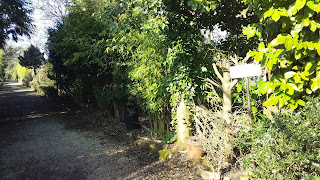
Miraculously, as the city grew, this "garden area" survived protected, probably because citizens of Amsterdam refused to give up on the idea of having a little quiet zone still relatively close to them. Where in other countries (like my homeland, for example) weekend houses are usually some distance from city and demand car transportation, this garden zone can be easily reached by public transport or simply a bike - come weekend, you can just ride here and spend the day (or weekend) taking care of your little plot and return home in the evening. I had a beautiful, peaceful walk trough a park and everybody was behaving very nice, there was absolutely no noise (forbidden!), people were sunbathing in their gardens, I saw several solar panels and it was just magic. And this was still a relatively cold, early Spring day so surely it looks even more magic later in the Summer! Can't wait to visit it again!


Luckily for me, I live in a cultured city with a lots of little art cinemas and right now they were showing a mini retrospective of a famous Japanese director Yasujirō Ozu - who is very highly praised by film critics but nowhere near known as Akira Kurosawa in my opinion. It might be that he is one of those cult figures known to his fans and followers. A friend was pointing me at his direction for a longest time and I did watch "Late Spring" (1949) but it was strange experience - this way of film making is so different than anything in the West that I wasn't sure what to think of it. It is like entering a completely new world with its own rules and aesthetic, definitely an acquired taste. However, Ozu kept lingering somewhere at the back of my mind so I welcomed this retrospective and two days in a row walked after work to a local little art cinema to watch these movies.

"Early Spring" (1956) was like typical Ozu movie incredibly slow. I mean, dead slow. The man had a style where everything important was happening outside of the camera and we are only casually told that something happened elsewhere. For example, a typical Ozu dialogue goes like this:
"Would you like a cup of Tea?"
"Yes, I would like a cup of Tea"
"Here is your cup of Tea"
"Thank you'
It is difficult to describe exactly what is the story of this movie because there is no main story - we follow several intertwined lives of individuals working for big corporate company and how they all slowly come to realise this is their life and their destiny, to be a little wheel in a grinding mechanism that will eventually replace them one day. Ryō Ikebe lives in a cold, loveless marriage with Chikage Awashima - later we find out what happened - and out of sheer emptiness has affair with a work colleague (radiant Keiko Kishi) all the while as we are introduced to people who are around him. Even though the story as such is basically non-existent and Ozu is more concerned about impressionistic outline of his character's feelings, something very beautiful happens along the way and suddenly I found myself truly caring about them and being indeed very moved by it all. It was truly like a magic - once you get caught up in his style and slow-burning story, suddenly it feels just right and you actually enjoy it. It have actually left the cinema all dazed and it stayed with me for a long time.

"Tokyo Story" (1953) has a gigantic reputation as one fo the best movies of all time (if not THE best) and according to critics it enjoys totemic place in the history - actually I would not say that is any better than two previous movies I have seen by Ozu. Each of them is like some beautiful dream that is slowly unfolding (very, very slowly) and perhaps the only reason why "Tokyo Story" resonates so much with audiences across the time and place is because it touches a nerve common to everybody, namely the question of parents getting older and children living their lives. Where ""Late Spring" dealt with arranged marriage of unwed spinster and "Early Spring" with adulterous affair, "Tokyo Story" is about the passage of time and how we all find our places in life - parents get old, children grow up and must live their lives. Its interesting to recognise the actors that Ozu preferred for his movies - it is only my third Ozu movie but I can tell he loves the very much the same team, including wonderful Setsuko Hara and Haruko Sugimura. Again, it was very slow but at this point I kinda knew what to expect so didn't really mind, this was his style. These movies are not for everybody and it might be that viewer must be in particular frame of mind in order to enjoy them - if you are looking for lots of action, this is definitely not for you - this is more philosophic reflection on life and very stylish cinema that gets under your skin. Be warned, the other "entertaining" movies might look very banal after this.

I really don't know what was I thinking - probably because for such a long time we took Jack the Ripper story as some exciting thriller and unsolved crime story, we became kind of conditioned to approach it as entertainment: historian Hallie Rubenhold took completely new and fresh approach, where she completely skipped killer himself and focused exclusively on the victims, trying to explain who they were, giving them names and explaining their background."They are worth more to us than the empty human shells we have taken them for; they were children who cried for their mothers, they were young women who fell in love; they endured childbirth, the death of parents; they laughed, and they celebrated Christmas. They argued with their siblings, they wept, they dreamed, they hurt, they enjoyed small triumphs. The courses their lives took mirrored that of so many other women of the Victorian age, and yet were so singular in the way they ended." For Rubenhold the identity of the murderer and all the grisly details are not important - they were excessively covered in many other places previously and we know too well how the mutilated bodies looked like when they were found - she decidedly focuses on lives not the deaths of five victims and tries to explain what was the reality of life in Victorian London.

Perhaps this book could not have been written earlier - it took a writer with modern sensibilities to look closer at the identity of victims and see them as a real human beings and not just crime statistics. Each of them was somebody's child, wife, lover and even (in some cases) mother. You can almost feel the tears of rage when Rubenhold discusses that they were probably not even prostitutes but homeless women - the fact that for some reason means a lot to her but does not change anything - what comes out very vividly is description of poverty and homelessness on the streets of London at the time. It is extremely detailed and often exhausting story - we learn a lot of ugly facts - each of these women starts relatively fine and than sinks in despair of poverty, alcoholism, homelessness, etc - I must be honest and admit that halfway trough the book it became quite repetitious and bleak. Kudos to Rubenhold for not trying to whitewash anything - she might have sympathise with these unfortunate women but she still gives pretty clear-eyed description of how self-destructive they were.

It was bleak and gloomy read. It could have not been otherwise, being about homeless and desperately poor alcoholics. These women were basically victims from the start but as Rubenhold points, there always was way out - marriage, service job, any job, moving to another town, etc - unfortunately many of them succumbed to alcohol addiction and ended up in a gutter. I read this with a knot in my stomach and now need something completely different, something entertaining.

Shoulder to shoulder with Arsen Dedić and Hrvoje Hegedušić, Zvonko Špišić created the soundscape of homegrown chanson - each of them had to go trough slightly embarrassing pop apprenticeship before they discovered their own, distinctive voice and even though sometimes it looks as everything was fight with the windmills (going against the mainstream) their music is still lovely and timeless as ever. Dedić might have been more prolific but each of them was also quite successful as composer, Špišić for example might not have been commercial singer himself but he composed several massive hits for others ("Suza Za Zagorske Brege", "Zvona Moga Grada", "Barbara", "Dobra Veče, Uzorita", "Dalmatinska Elegija") so his music was fairly popular, even if he was not upfront himself.

This early 1970s came out at the time when Jugoton just started releasing full blown LP albums of their biggest stars - mainly artists who already had some back catalogue from 1960s and now re-recorded old songs in stereo. Interestingly, Špišić sidestepped lightweight pop from earlier singles and focused on serious repertoire, mostly composed by himself and with lyrics of people like Vesna Parun. It is a breathtakingly beautiful album, full of poetry and introspective songs, almost little music dramas with interesting characters ("Kockar", "Trešnjevačka Balada") and unforgettable images ("Vrata Ruža"). Even though he was not what you would call pop singer, these songs were often played on the radio and to some extent he represented urban sound that appealed to literate audiences who would actually visit concerts, theatres and exhibitions. I have met the man during my early years as a journalist and he was a perfect gentleman, his music still etched in my heart after all these years. Beautifully orchestrated and performed, this is the peak of our chanson.


Very beautiful tribute to Dusty Springfield who have passed away from cancer just a year before. Springfield was remember as the quintessential British 1960s female pop star and the point can be made that she will forever be associated with that particular decade, although - as this collection shows - her career stretches way before and after that period. It feels as there is a lots of love and affection involved into this compilation, starting from impressionistic little song "Dusty Springfield" by Blossom Dearie (who has also written songs about Lennon, etc) to a sheer spectrum of her golden years and beyond. Quite a lot of space is given to her initial false starts with groups The Lana Sisters and The Springfields which serves as example of pre-Beatles music world and makes her later solo work even more impressive - basically, once she had found her own voice, Springfield created body of work that was quite timeless.

Considering how much attention was given to her iconic 1960s looks, its interesting to note what matters the most is her music and under all that cellophane & distractions, the music was glorious. It was inspired combination of girl group sound, Phil Spector and Motown, filtered trough her particular sensibilities - by borrowing from here and there, Springfield has created her own individual style that was recognised as deeply soulful even though her voice had nothing to do with rough edged soul screamers so popular back than. If anything, Springfield was vulnerable, tender and fragile - even though she is praised as a foremost British blue eyed singer, her individual touch was soft and gentle. Surprisingly, she could easily adapt to anything thrown at her and for the most of this compilation it worked perfectly - no matter what genre or production, she had always her own idiosyncratic sound.
With such impressive repertoire, there is hardly a misstep during 1960s but afterwards it feels as Springfield has lost the steam a bit - its as her razor-sharp instinct have suddenly deserted her and suddenly it all turns MOR - there is a noticeable loss of focus in her later career, as she was unsure does the path leads to Las Vegas or movie soundtracks. Still, the voice was always magnificent and majority of this collection is now classic.

Yesterday we were hit by the storm Eunice - in case if you wondered, the storms have names to distinguish them from each other and apparently here in Europe we do it since 2015 - names are given when meteorologists expect they will be dangerous - we were given warning in advance and everybody who is following the news knew there is extremely bad weather coming. The wind was 130 km per hour and it was quite alarming, with the trees falling down and rooftops being completely blown away. This did not come without a warning - again, I must repeat that we were told about coming storm a day before and media was constantly informing us that all the public transport will be closed, ferries, trains and planes were cancelled (though apparently some international flights continued) - at one point the whole country got NL-Alert, asking them to remain inside, and warning them that emergency phone lines were overloaded.


With all of this, some people still felt as they must go outside and do something terribly important. As a result, four people died in accidents. Now, we knew even the time when the storm will start - that is why I did my groceries first thing in the morning, knowing that later I will have to stay indoors. I got all that I need and cancelled my romantic date (there is absolutely nothing that could not wait until next day) so when the storm arrived around 14:00 I was safely tucked inside. And still four people did not believe the news, would not listen to advice and had to go around while the trees and rooftops were falling all over the place. They didn't have to die - if only they listened, they would still be alive today - but just as with Covid, people always think they know better and in this case died from their own stupidity. Yes, stupidity. There is no other explanation or expression to describe the reaction to alarm released on national level, where despite everything that has been said, people still refuse to listen because they think they know better. I have literary 0 patience for this kind of behaviour and feel no sorry for people like these.


Luckily for us, the storm happened on a weekend - many people have left their jobs earlier to be able to come home safely on time - but now it looks as there might be another storm coming on Monday, which will be a little difficult to avoid since people must continue with their works. I guess that in case of real emergency there might be some more alarm and everybody will go home earlier.

The comet is hurling towards planet Earth and to their surprise and despair, two astronomers find out that humanity is too preoccupied with their own little interests and social media to actually give a damn.
I was intrigued with the premise, because apparently it was breaking all the records on Netflix and it kind of sounded interesting - tons of really big stars made it look like "Mars attacks!" which is one of my favourite movies and also brimming with celebrities - however, the similarities were just superficial because this one wasn't really a comedy. It was advertised as black comedy or satire but everything about it was a bit too disturbing to actually be genuinely funny. Yes, I chuckled a few times, specially when Leonardo DiCaprio freaks out in a children's TV show that looks like Sesame Street or basically every time Meryl Streep was hamming it up as a President of the United States (undoubtedly inspired by you-know-who) but the overall tone of the movie was so snarling that all this irony actually just depressed me. Yes, I got it, its not about the comet but about the climate change - but hammering it on so obviously made my heart sink lower and lower, until the end of the movie I was disturbed with all that selfishness, egocentrism and superficiality. Perhaps I am reading too much into something that was basically created as a comedy, but I like to think that the world around me is not so cynical - even if it is, we are the one who create our own perspective of it.

I also have to admit that I am not familiar with director Adam McKay, perhaps this is what he does: it wasn't really enjoyable, more like he was forcing a mirror into our faces. The overall impression was one of many nasty people backstabbing and smirking at each other.

I was thrilled to death when I heard that there will be a new version of "West Side Story" and that it will be directed by no other but Steven Spielberg - it is one of my all-time favourite musicals ever and Spielberg for me epitomises big-budgeted, glamorous and shiny Hollywood so I just couldn't understand negative reactions online by the fans of 1961. movie - people complaining that the old movie was perfect as it was and it should never be touched again. I think the main reason for this confusion is the fact that movie audiences refuse to accept remakes, while constant and perpetual remaking is the heart and soul of the theatre - live audiences are used to the re-imagining and re-direction of live plays, in fact it is welcomed and expected that each generation must bring something new and fresh to the known scripts. "West Side Story" started its life as a theatre musical and its lyricist, late Stephen Sondheim have recently said that he loves the fact that it goes on with new talents and energy. I am very familiar with the musical, since in addition to Original 1957. Broadway Cast album I also own versions by André Previn, vibraphonist Cal Tjader, Oscar Peterson and Stan Kenton Orchestra, but the very first time I was familiar with the music was trough Barbra Streisand who have extensively covered songs on her "Broadway" albums - I have also seen it live on the theatre stage but strangely I never liked the celebrated 1961. movie; for all its hoopla, choreography and 10 Oscars I had something else in my head and imagined it far more powerfully than what was on the screen.

The new movie was apparently finished long time ago but its premiere was perpetually postponed because of the world's epidemics - the resulting financial disappointment is something that gleeful critics never fail to point, but its not about movie or Spielberg, it is simply that audiences are staying away from the cinemas. There was a particularly nasty review in "The New Yorker" that said how "rich and famous artist spends a hundred million dollars to revive a corpse with the blood of young people" - I refused to to read it after the first sentence. And naturally there was similar backlash from a constant snowflakes complaining about everything - that this movie continued old racial stereotypes, etc - same people who complained about "Porgy & Bess" or those who wanted to destroy old movies with Bessie Smith because they didn't like what they saw. I had to wait forever (thrilled with the phenomenal trailer) because of our lockdowns and also had to keep in mind that majority of people immensely dislike musicals - when the time finally came, I went to see it by myself because I didn't want anybody to distract me with moaning and complaining. (I still remember with embarrassment how the whole cinema moaned and laughed when Streisand sang again during "Yentl" - seriously people, ever heard of musical? This is back in my homeland and people around me were absolutely dead set against musicals.)

Dear reader, I was so excited and hypnotised with everything on the screen, that I had a smile and tears rolling down my face like idiot - from the very first opening whenThe Jets start dancing and gliding trough the streets of derelict Manhattan neighbourhood (that was to be demolished) I was completely besotted, smiling, humming and drumming with my fingers - Spielberg took the old musical and pumped everything to maximum, making everything bigger, massive, louder and better. I felt as he took ancient piece of furniture that was too long covered with the dust and polished it to perfection, gave it a new coating, made it spectacular as it should always have been. This is what I had in mind when I listened music, not skinny, fake-tan Puerto Ricans from 1961. movie. Also must mention that the newly recorded music sound brilliant. And the odd experiment of untranslated Spanish didn't bother me at all, because it made sense and everything was still easy to understand. For me this was the movie craftsmanship of the highest order and I was enjoying it immensely, specially when Tony and Maria finally meet on a dance and later sing to each other on the balcony - Spielberg played me like a violin here and I was in the movie Heaven right than and there.

Unfortunately, its not 100% perfect - it goes a little bit too long and there were clearly some compromises done to avoid any political incorrectness. The final 30 minutes were very downbeat and even though this has nothing to do with Spielberg (basically this is the story) it felt as it was dragging on forever. At this point I even start to feel dislike for angelic Rachel Zegler (Maria) who started to get on my nerves being so one dimensional (not surprisingly, she is set to play Snowhite in upcoming Disney movie). Actually to be honest, I wasn't seriously fascinated with neither Tony nor Maria as much as I enjoyed charismatic Puerto Rican couple David Alvarez (boxer Bernardo) and Ariana DeBose (fierce Anita) who for me were real stars of the movie, but originally were just supporting characters. I must not forget Mike Faist as Riff (one of The Jets) who was constantly antagonist until in one particular moment, he breaks your heart. The original Anita (Rita Moreno) was also here and she was fine, though not terribly important - she is a small, supporting character in a movie about young people. I was also intrigued by Corey Stoll as policeman, who had enough charisma to stand up to both Jets and Sharks - when he speaks, they all stand still. I don't remember when was the last time I enjoyed musical so much - in fact I am already looking forward to go and see it again. In the cinema.

"No one would have believed in the last years of the nineteenth century that this world was being watched keenly and closely by intelligences greater than man's and yet as mortal as his own; that as men busied themselves about their various concerns they were scrutinised and studied, perhaps almost as narrowly as a man with a microscope might scrutinise the transient creatures that swarm and multiply in a drop of water. With infinite complacency men went to and fro over this globe about their little affairs, serene in their assurance of their empire over matter. It is possible that the infusoria under the microscope do the same."

The unnamed protagonist witnesses strange spaceship landing near his home in Surrey - at the moment nobody connects this with strange explosions on Mars some time ago - while amused locals swarm the area and poke at the metal cylinder, what eventually emerges out of it are dangerous Aliens who continue to kill, burn and destroy everything on their path. Simultaneously, we follow the protagonist in Surrey (where the landing happened) and his brother in London (where initially citizens don't grasp the seriousness of situation).
Dear reader, you might wonder why am I reading such apocalyptic novel in stressful times as these but in fact I always loved H. G. Wells, was planning to explore some more of science fiction genre, needed something gripping that would help me with pure joy of reading and - last but not least - I actually don't remember ever reading this before. There were zillion adaptations but I don't care for them, this is the real thing. And its right up my alley, since I was always annoyed with naivety so predominant during my childhood, where media praised Aliens as friendly and wise - you know, they will come and make this planet suddenly peaceful and loving - the unknown species might as well be some giant insects ready to gorge on whoever they find on planet Earth. I genuinely believe that life forms here very possibly reflect life forms somewhere out there, but in a changed size or shape - so rather than a gentle, friendly E.T or wise Yoda, I expect Aliens might come as cockroaches or octopuses. H. G. Wells shared my opinion, because his Martians are definitely not here to teach us how to be kind and wise - they suck the blood out of us and burn everything on their path. Interestingly, this is not your typical adventure novel with a heroic character winning the fight - everybody here is relatively selfish, inconsiderate or simply mad with fear. People are looting, breaking into empty houses, stealing horses and trampling each other in panicking crowds. I find it all surprisingly realistic, dark and very gripping.


